
Optimizing Your Fertilizer Production Line: Why What Your SOP Fertilizer Contains Matters for Process Efficiency
Introduction: The Direct Link Between Composition and Efficiency
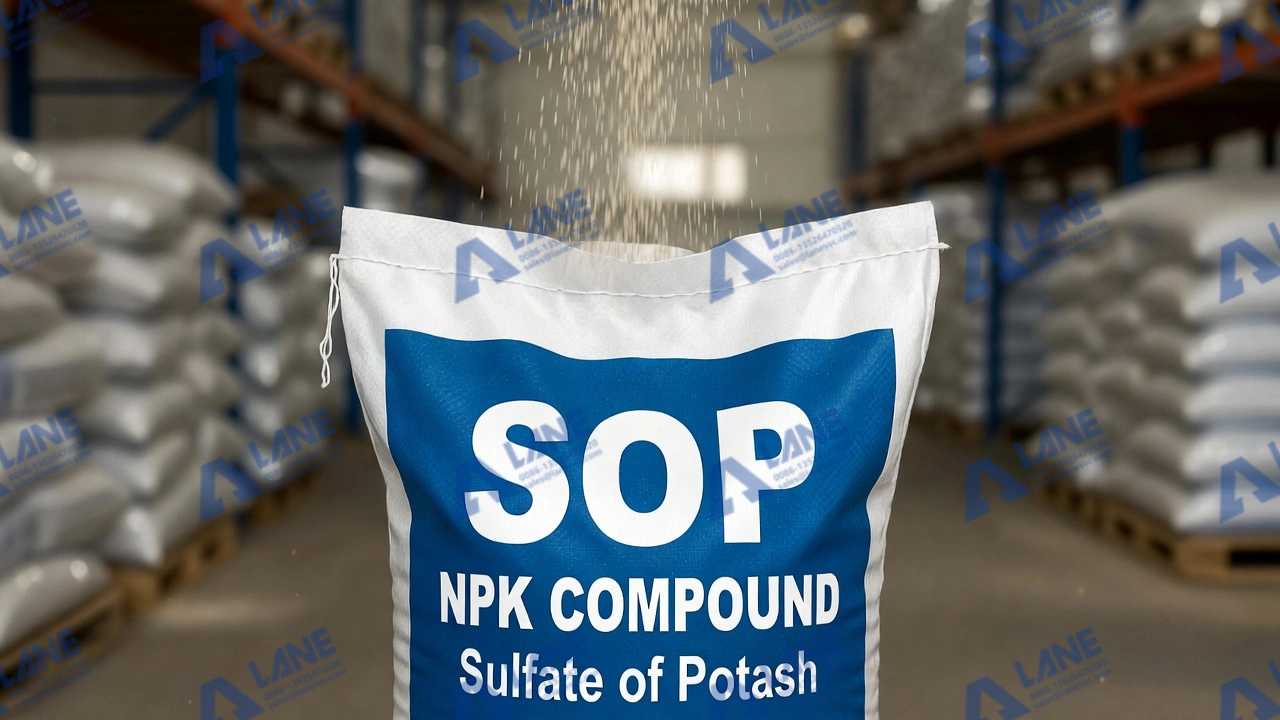
In the competitive world of the specialty fertilizer market, sulfate of potash (SOP) holds a crucial position due to its low chloride content. Its low chloride content makes it ideal for cash crops such as fruits, vegetables, and tobacco. For producers of high-value Sulfate of Potash (SOP), efficiency is what determines their profit. For SOP fertilizer producers, efficiency is not just about precision, consistency, and minimizing waste.
SOP fertilizer is different from other potassium fertilizers. Its main components include potassium sulfate (K₂SO₄) with a potassium oxide (K₂O) content of not less than 50%, and strict limits on chloride ion content (generally not more than 1.5%). The chemical compounds your SOP fertilizer contains are what dictate the performance of your entire fertilizer production line. Your raw materials are the most important part of your production.
This article explains SOP composition, combined with machinery from partners like LANE Heavy Industry, to create a seamlessly optimized production process.
The Core Components: What SOP Fertilizer Contains and Why It’s Critical
SOP (K₂SO₄) is popular for its chlorine-free, dual-nutrient profile. However, in commercial fertilizer, it’s rarely 100% pure potassium. The final SOP fertilizer contents are determined by the raw materials (e.g., Mannheim process by-products, natural brines, or potassium chloride reactants) and your formulations.
Key components are:
- Primary Nutrients: Potassium (K₂O) and Sulfur (S) in sulfate form.
- Moisture Content: Typically water or sulfuric acid, or both. It’s a critical physical parameter affecting flow and granulation.
- Trace Elements: Such as Magnesium, Calcium, or Sodium. These can be beneficial or problematic depending on the crop situation.
- Residual Acids or Chlorides: Dependent on the production process (e.g., Mannheim).
How Composition Dictates Production Line Performance
The job of a production line is to create a final product from your raw materials. The composition of the final product depends largely on the raw material’s performance. Here’s how:
Granulation/Densification: Moisture content, granule hardness, and binders (like certain sulfates or clays) in your SOP fertilizer will determine your granulation speed, liquid mixing, and residence time. Material with inconsistent moisture will lead to over-wetting and lump formation or under-wetting and excessive fines.
Drying: The thermal stability and moisture of SOP fertilizer granules are important for packing. If your SOP fertilizer contains higher impurities, it can lower the melting point or cause caking. An effective dryer, like the one supplied by LANE, provides precise temperature control tailored to the specific production line.
Cooling: After drying, it is required to properly cool the granules. Properly cooled granules are essential for screening and bagging. Inefficient cooling leads to post-storage caking and screening challenges.
Screening & Recycling: Screening separates the on-size granules from the oversized particles and oversize granules. The oversized granules are sent to your crusher to be recycled, and the on-size granules are sent to the packing machine for final packaging.
The LANE Heavy Industry Machinery Advantage: Precision for Demanding SOP
To handle the precise demands of your SOP fertilizer contents, your production line requires durable, adaptable, and intelligently controlled machinery. This is where LANE Heavy Industry can help you create your dream production line.
LANE Rotary Granulator:The LANE rotary granulator is designed with adjustable speed. It allows the operators to fine-tune the granulation action in real-time based on the raw material’s consistency and moisture.
LANE Rotary Drum Dryer & Cooler:LANE dryers and coolers are designed for temperature control. These units ensure uniform heat transfer and efficient cooling. This makes the drying and cooling process more streamlined and efficient.
LANE Vibrating Screen & Crusher System: The vibrating screen machine is made for precise separation of on-size particles from oversize and dust particles. The oversized material and dust are sent to the LANE crusher for recycling.
Integrated Control Systems: LANE’s focus on automation allows for seamless SOP fertilizer production. The production line has sensor feedback from key points. It creates a responsive system that can detect even
minor fluctuations in raw materials.
Key Stages Where Analysis of What Your SOP Fertilizer Contains is Non-Negotiable
Your production line needs data to optimize. You should implement rigorous, frequent analysis at critical control points.
Raw Material/Pre-Granulation Feed: Analyze moisture, particle size distribution, and chemical composition. This data gives you the information upon which you can determine the parameters for the granulation and drying stages.
Post-Dryer Analysis: Verify the moisture content and granule strength before packaging. This confirms the drying and cooling efficiency.
Final Product Certification: To supply your fertilizer in the European market, you will need precise data about your whole production. You will need to provide nutrient grade, moisture content, and granule hardness.
A simple table can guide this process:
| Production Stage | Key “Contains” Parameter to Monitor | Impact on Line Efficiency |
| Pre-Granulation | Moisture Content, Fines Percentage | Determines binder addition, affects granulation yield & recycle load. |
| Post-Dryer | Final Moisture, Granule Integrity | Indicates dryer efficiency; affects cooling load and screening rate. |
| Post-Cooling | Granule Temperature, Friability | Prevents caking in storage; ensures smooth bagging and minimal dust. |
| Final Product | Nutrient Analysis, Hardness, Size Guide Number (SGN) | Validates entire process setup; ensures customer spec compliance. |
Conclusion: A Strategic Approach to SOP Production
The content of sulphate of potash fertilizer is closely related to the process efficiency of the production line and the sop fertilizer contains is the key link to connect the two. By pairing this compositional intelligence with the durable, precise, and adaptable machinery from LANE Heavy Industry, producers can transform their SOP production line into a highly optimized, responsive system.
Frequently Asked Questions (FAQ)
Q1: Why is the moisture content in what my SOP fertilizer contains so critical for the production line?
A: Moisture is the primary binder in granulation. Too little moisture leads to poor granule formation, creating excessive fines that overload the recycle system. Too much moisture causes agglomeration and lumping, which can block dryers and coolers, leading to downtime and inefficient energy use. Precise moisture control is essential for steady-state operation.
Q2: Can LANE Heavy Industry machinery handle different SOP production methods (e.g., Mannheim vs. brine crystallization)?
A: Yes. While the core mechanical processes (granulation, drying, cooling) are similar, the starting material properties differ. LANE equipment is designed for adjustability and robustness. The key is to provide LANE engineers with the specific characteristics of your feedstock (e.g., acidity from Mannheim process, specific crystal shape from brine) so the system can be configured or tailored with appropriate material alloys and control logic during the design phase.
Q3: How does understanding what my SOP fertilizer contains help reduce energy costs?
A: Energy is heavily consumed in drying and cooling. If you precisely know the moisture content and thermal properties of your material, you can operate your LANE dryer at the optimal temperature and airflow, avoiding “over-drying.” Similarly, efficient cooling prevents heat from disrupting downstream packaging. This precision eliminates energy waste.
Q4: We often face caking issues after bagging. Is this a production line problem or a product problem?
A: It is almost always a combination of both, rooted in composition. Caking occurs due to residual moisture, improper cooling (leaving “heat pockets”), or the hygroscopic nature of certain impurities in the SOP. Optimizing the drying and cooling stages with properly sized LANE equipment, based on your product’s specific analysis, is the most effective way to eliminate this costly issue.
Of course, we also offer other types of products for your different needs, you can click to view.
For more information, please contact us by sending an inquiry today! We can help you!



Write a Reply or Comment