
SOP VS MOP In NPK Fertilizer Production: Process Flow, Equipment & Output
Introduction
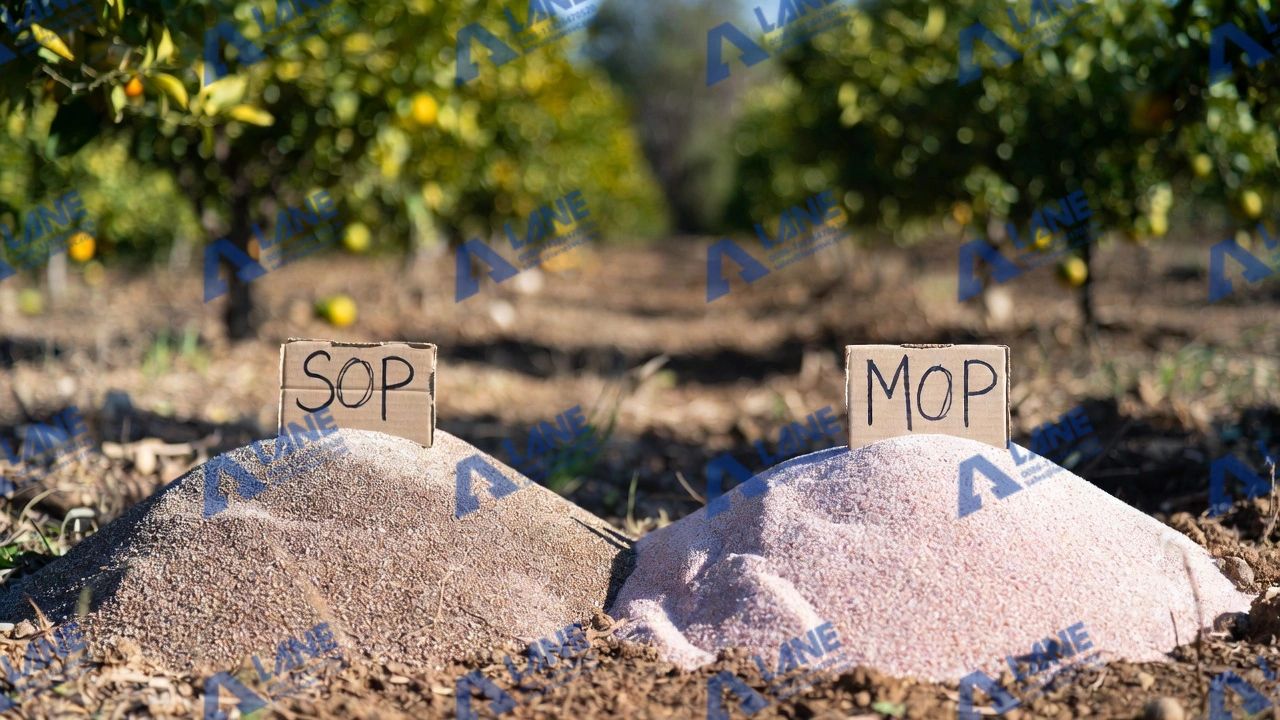
Potassium is a critical nutrient for crop growth, quality, and resistance. SOP vs MOP in NPK fertilizer production is a critical topic for manufacturers and farmers alike. While both SOP (Sulphate of Potash) and MOP (Muriate of Potash) are potassium-rich fertilizers, their production processes, equipment requirements, and outputs are different. Understanding SOP vs MOP in NPK fertilizer production is essential for manufacturers aiming to deliver high-quality NPK fertilizers.
LANE Heavy Industry, a leader in fertilizer machinery, offers industrial solutions for producing high-quality NPK fertilizers. Our production lines can integrate both SOP and MOP production lines into efficient manufacturing systems. This article provides a comprehensive comparison of SOP vs MOP in NPK fertilizer production, focusing on process flow and specialized equipment from LANE Heavy Industry Machinery.
Understanding SOP and MOP
SOP (Sulphate of Potash) is a premium fertilizer with a high potassium and sulfur content and low chloride levels. It is preferred for chloride-sensitive crops such as fruits, vegetables, and tobacco. Its chemical formula is K₂SO₄.
MOP (Muriate of Potash), or potassium chloride (KCl), is the most used potassium fertilizer worldwide. It contains higher K₂O content than SOP but it also has up to 47% chloride, which is harmful for chloride-sensitive crops.
The production choice between SOP and MOP depends on soil conditions, crop type, and desired yield. In the context of NPK fertilizer production, both SOP and MOP are used as potassium sources. The production machines must have the ability to accommodate their chemical and physical properties.

SOP vs MOP in NPK Fertilizer Production: Process Flow
- Raw Material Preparation
For both SOP and MOP in NPK fertilizer production, the first step is handling the raw materials and preparing them. Key inputs include:
- Nitrogen sources: Urea, ammonium nitrate
- Phosphorus sources: DAP, TSP
- Potassium sources: SOP or MOP
Raw materials are carefully weighed, crushed, and screened to ensure uniform particle size, which is critical for consistent NPK granulation.
LANE Heavy Industry’s horizontal mixer or double shaft mixer ensures uniform distribution of nitrogen, phosphorus, and potassium compounds. During this stage:
- SOP blending requires careful handling due to its lower hygroscopicity and chloride-free composition.
- MOP blending needs moisture control because MOP is highly hygroscopic and prone to caking.
- Granulation
Granulation transforms the powdered mixture into uniform granules. LANE Heavy Industry provides precise durable granulators suitable for both SOP and MOP-based NPK fertilizers:
- Rotary drum granulator: High capacity, suitable for large-scale production.
- Pan granulator: Ideal for precise control of granule size in SOP production.
- Double Roller Granulator: Best for dry granulation. It is an energy-efficient method as this method doesn’t require drying.
The granulation process also differs in binder usage. SOP-based NPK often requires a different binder formulation compared to MOP-based NPK to maintain granule integrity.
After the wet granulation process, the fertilizer must be dried and cooled for better storage and transportation.
- Drying: LANE’s rotary dryer removes excess moisture to prevent caking. SOP granules, being less hygroscopic, may require slightly less drying time than MOP granules.
- Cooling: LANE’s rotary cooler uses ambient air to ensure granules are stable for storage and packaging.
LANE Heavy Industry’s rotary drum dryer and cooler are designed for both SOP and MOP in NPK fertilizer production. This offers precise temperature control to avoid nutrient loss.
The dried granules are screened to separate fine powder from qualified fertilizer granules. Additionally, a coating process may be applied to reduce dust, prevent caking, and enhance nutrient stability. SOP granules generally respond better to coatings due to their non-hygroscopic nature.
Finally, NPK fertilizers containing SOP or MOP are packaged using automated systems. This ensures accurate weight and protection from moisture. The packaging stage completes the SOP vs MOP in NPK fertilizer production cycle, ready for market distribution.
Equipment Used in SOP vs MOP in NPK Fertilizer Production
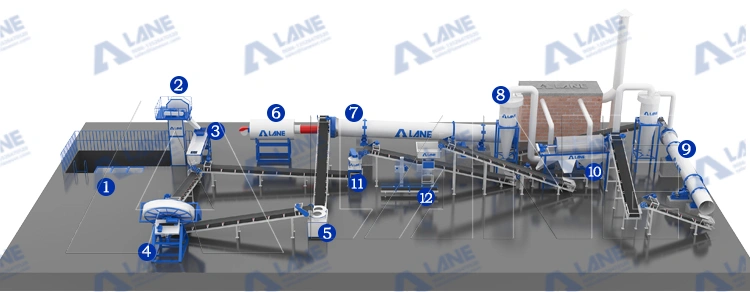
LANE Heavy Industry provides a complete suite of equipment designed to handle the specific challenges of SOP and MOP production:
- Raw Material Crusher & Grinder: Ensures consistent particle size for blending.
- Dynamic Batching & Weighing System: It measures and provides accurate dosing of nitrogen, phosphorus, and potassium sources.
- Granulators: Rotary drum granulator, pan granulator, or double roller granulator depending on production scale.
- Rotary Drum Dryer & Cooler: These machines dry and cool the products while maintaining nutrient integrity.
- Screening Machines: Rotary screening machine separates oversized and undersized granules.
- Coating Machine: Coating machine improves granule quality and shelf life.
- Packing Machine: Automatic packaging for bulk and bagged fertilizer products.
LANE’s integrated production lines are modular. It allows manufacturers to switch between SOP and MOP production with minimal downtime. This flexibility is crucial for meeting market demands and optimizing SOP vs MOP in NPK fertilizer production efficiency.
Output & Quality Characteristics of SOP vs MOP in NPK Fertilizer Production
The final output of SOP vs MOP in NPK fertilizer production is different in nutrient composition and physical properties:
- SOP-based NPK: Chloride-free, suitable for sensitive crops, uniform granules, slightly lower K₂O content.
- MOP-based NPK: Higher K₂O content, more affordable, but chloride presence limits use for certain crops.
Both potassium sources can be used in LANE Heavy Industry’s NPK fertilizer production equipment. Our machines ensure uniform blending of nutrients, excellent granule strength, and minimal dust.
Advantages of LANE Heavy Industry Fertilizer Production Lines
- High efficiency: Our machines are optimized for SOP and MOP granulation.
- Customizable output: Adjust nutrient ratios according to market demand.
- Energy-saving technology: The production line reduces operational costs while maintaining output quality.
- Scalability: We have designed the NPK production line for small to large scale operations.
- Environmental compliance: We implement dust control and material recycling into our production line.
Conclusion
Understanding SOP vs MOP in NPK fertilizer production is vital for modern fertilizer manufacturing. It will help manufacturers and farmers create formulations based on crop and soil quality. SOP vs MOP in NPK fertilizer production impacts process flow, equipment requirements, output quality, and market positioning. LANE Heavy Industry’s flexible, high-efficiency NPK production line addresses the unique needs of both SOP and MOP production. Our production line allows manufacturers to adapt to market demands by using high-efficiency cutting-edge technology
Frequently Asked Questions (FAQ)
Q1: What is the main difference between SOP and MOP in NPK fertilizer production?
A: SOP is potassium sulfate, chloride-free, suitable for sensitive crops, while MOP is potassium chloride, higher in K2O but contains chloride.
Q2: Can the same production line handle both SOP and MOP?
A: Yes, LANE Heavy Industry designs modular lines that can switch between SOP and MOP with minimal adjustments.
Q3: Which fertilizer is better for vegetable crops?
A: SOP-based NPK is generally better because it is chloride-free, which prevents toxicity in sensitive crops.
Q4: Does SOP production cost more than MOP production?
A: Typically, yes. SOP raw materials are more expensive, and the process requires more careful handling.
Of course, we also offer other types of products for your different needs, you can click to view.
For more information, please contact us by sending an inquiry today! We can help you!



Write a Reply or Comment