
The Rising Global Demand for High-Quality SOP Fertilizer Anti-Caking Formulation
The agricultural world is rapidly evolving and the quality of fertilizer directly impacts crop yield and quality and affects farm profitability. Farmers and fertilizer producers are seeking innovative solutions to improve crop yields while reducing losses. Among the solutions, Sulfate of Potash (SOP) fertilizer stands out. It is a chloride-free fertilizer that stands out for its dual nutrient value. SOP fertilizer anti-caking formulation is a premium formulation that delivers high-quality potassium sulfate without the common issue of clumping.
Clumping or caking reduces product quality, hinders handling, and compromises application efficiency. SOP fertilizer anti-caking formulation ensures that SOP fertilizer remains free-flowing, stable, and effective throughout its lifecycle. With the machinery from LANE Heavy Industry, manufacturers can now efficiently produce superior SOP fertilizer with anti-caking properties that meets international premium standards.
What is SOP Fertilizer Anti-Caking Formulation?
SOP (Sulphate of Potash) fertilizer is a highly soluble potassium sulfate nutrient source. It delivers potassium in a sulfate form. However, granular SOP is prone to caking and dusting. The SOP fertilizer anti-caking formulation solves this by applying specialized agents and processing techniques that maintain the granules.
Key benefits include:
- Enhanced handling and storage stability
- Uniform nutrient distribution
- Reduced wastage and labor costs
- Compatibility with automated spreading equipment
By incorporating anti-caking agents into the production, manufacturers can ensure that the fertilizer remains effective from production to application.
The SOP Fertilizer Production Line by LANE Heavy Industry
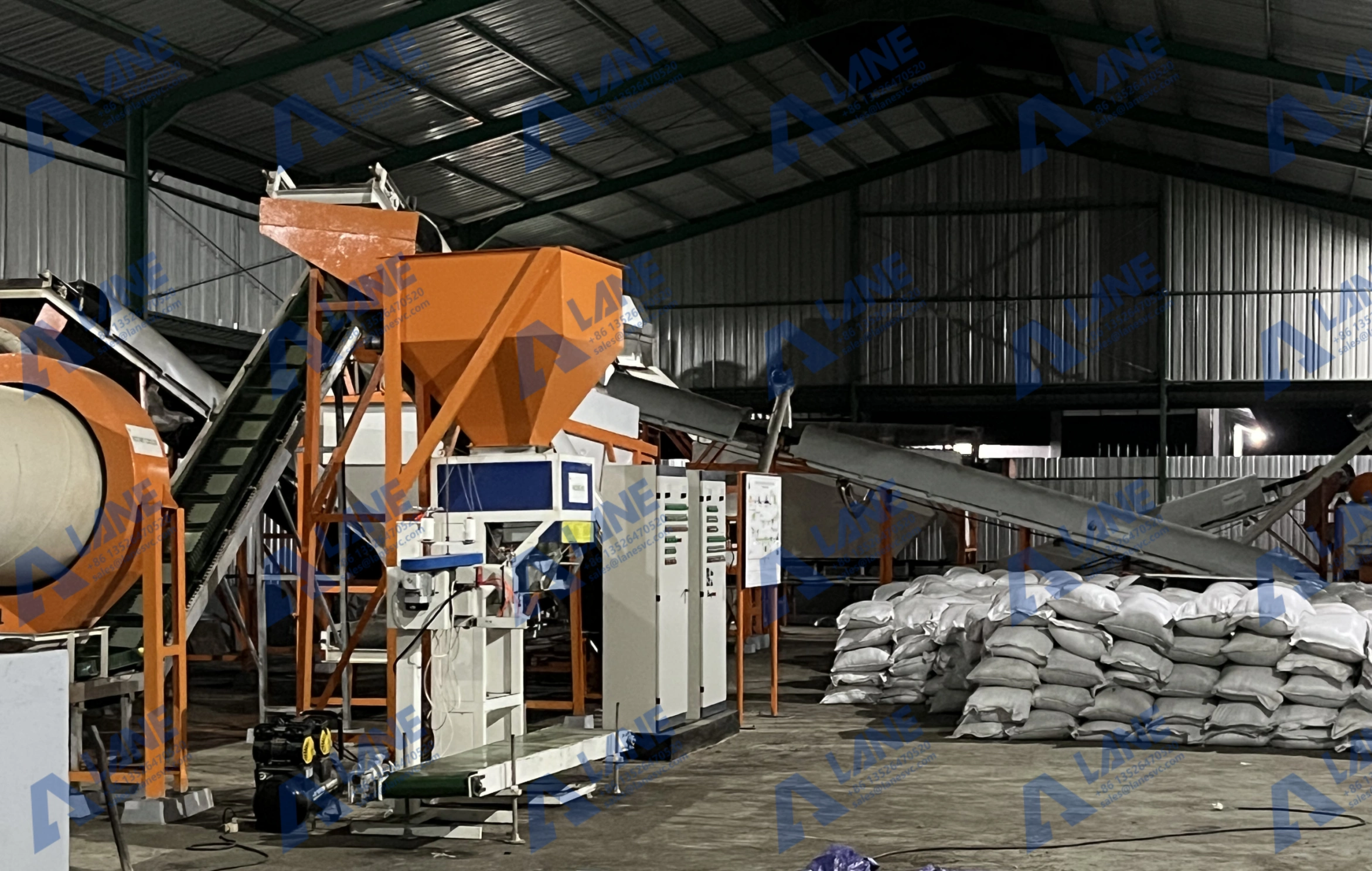
Producing high-quality SOP fertilizer anti-caking formulation requires machinery that can evenly spread the agents. LANE Heavy Industry offers a complete SOP fertilizer production line that can handle raw material to granulation to coating to packaging.
- Raw Material Preparation
The production process begins with precise measurement of the raw materials. LANE’s dynamic batching scale releases exact amounts of potassium sulfate and additives to the mixing machine. LANE’s horizontal mixer evenly mixes the formulations and ensures consistent raw material nutrient quality.
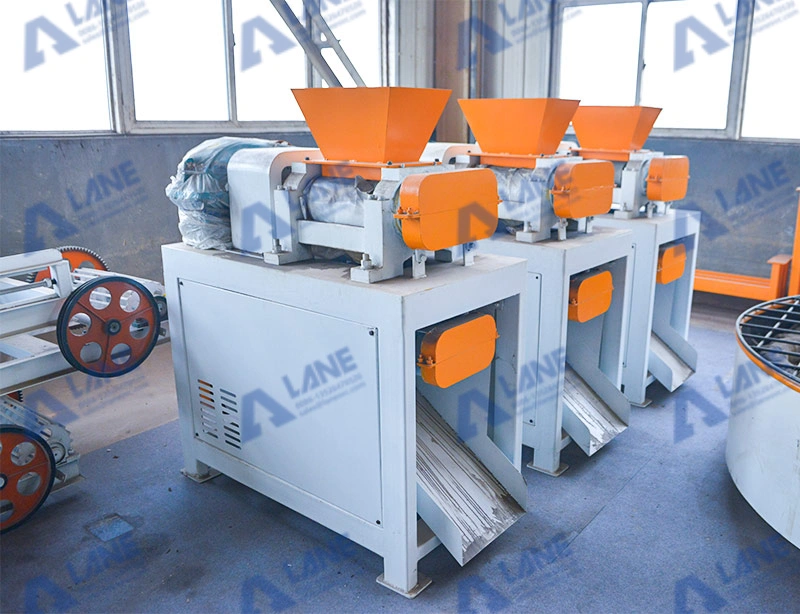
The mixed raw materials are then sent to LANE’s Rotary drum or Double roller granulator. These granulators provide controlled particle size and density and prevent clumping during drying and storage.
If the granulation method is a wet process, then the granules need to be dried before screening. LANE’s dryer reduces moisture content to an optimal level while coolers use ambient air to stabilize the granules. Proper moisture control is essential for maintaining the integrity of SOP fertilizer anti-caking formulation.
The cooled granules are then sent to the LANE Rotary Screener. In this machine, the on-size granules are separated from fines and over-sized granules. The fines and oversized granules are sent to a crusher and recycled back into the production line. The on-size granules are sent to the coating machines. LANE’s Rotary Drum Coating machine applies anti-caking agents uniformly across each granule. LANE’s advanced system ensures the coating adheres effectively and prevents caking and dusting.
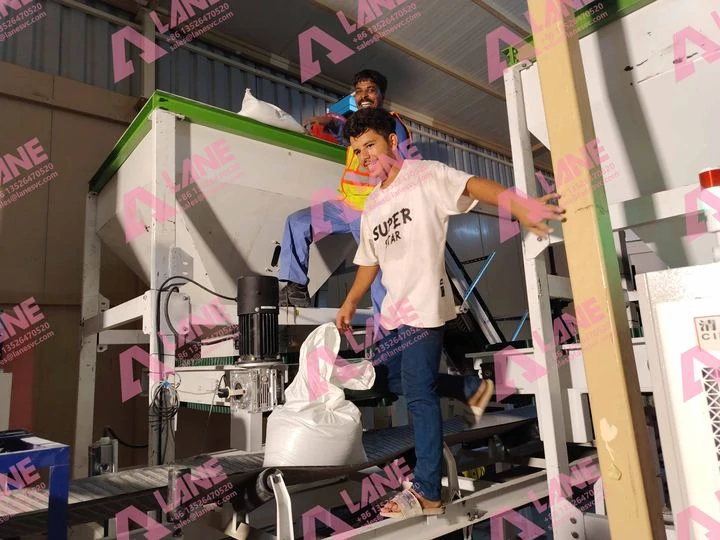
LANE provides a fully automatic packaging system to automate the entire packaging process. This ensures no human hand is involved and the anti-caking SOP fertilizer reaches the market in perfect condition.
Global Demand Trends for SOP Fertilizer Anti-Caking Formulation
The global demand for SOP fertilizer is rising and will continue to rise, because of:
- Intensification of Agriculture: Farmers need SOP fertilizer for chloride-sensitive cash crops for quality and high yield.
- Ease of Handling: Anti-caking formulations reduce storage and transportation challenges.
- Export Market Expansion: Free-flowing fertilizers are preferred in international trade.
Markets in Asia, Europe, and North America are adopting high-quality SOP fertilizer. As sustainable practices gain momentum, the demand for anti-caking formulations that minimize nutrient loss and ensure even application is stronger than ever.
Advantages of SOP Fertilizer Anti-Caking Formulation
The integration of anti-caking agents in SOP fertilizer provides multiple advantages for producers, distributors, and farmers:
- Improved Flowability: Granules remain free-flowing even in humid conditions. Free-flowing granules reduce handling difficulties.
- Consistent Nutrient Delivery: Even nutrient distribution ensures optimal plant growth, resulting in higher crop yields.
- Extended Shelf Life: Properly coated granules resist moisture-induced caking, maintaining quality during storage.
- Reduced Operational Costs: Easier handling and fewer losses translate to savings in labor and material costs.
Why LANE Heavy Industry Machinery is Ideal
LANE Heavy Industry specializes in efficient and precision fertilizer machinery designed for complete SOP production lines. Our production line contains:
- Reactors for the Mannheim process
- Crystallization and cooling systems
- HCl production systems
- Crushers for molten potassium sulfate and crystals
- Granulation, drying, cooling, screening, and coating equipment
- Automated packaging systems
- Automatic control systems and sensors for consistent product quality for anti-caking formulations
By using LANE machinery, manufacturers can scale production, improve product quality, and ensure compliance with global standards.
Sustainability in SOP Fertilizer Production
Environmental responsibility is important in agriculture. Modern manufacturers are exploring:
- Eco-friendly anti-caking agents
- Water-soluble and biodegradable coatings
- Energy-efficient production systems
LANE Heavy Industry offers machines and equipment capable of handling sustainable formulations without compromising efficiency. Our machines ensure that your SOP fertilizer anti-caking formulation production meets global demand while adhering to environmental standards.
Conclusion
As the global agricultural sector continues to evolve, the demand for high-quality SOP fertilizer anti-caking formulation will only grow. Farmers are aware of the benefits of SOP fertilizer and manufacturers are recognizing that SOP fertilizer anti-caking formulation is essential to delivering on these benefits. LANE Heavy Industry’s machinery enables manufacturers to produce free-flowing, high-quality SOP fertilizer efficiently for both domestic and international market quality. As agriculture continues to evolve, SOP fertilizer anti-caking formulation will remain essential for ensuring efficient nutrient delivery, reducing waste, and maximizing crop yields.
FAQ: SOP Fertilizer Anti-Caking Formulation
Q1: What makes SOP fertilizer anti-caking formulation different from regular SOP fertilizer?
A: Anti-caking formulations include additives or coatings that prevent clumping, making handling, storage, and application easier while maintaining nutrient integrity.
Q2: How does LANE Heavy Industry machinery improve SOP production?
A: LANE provides fully integrated production lines, from granulation to anti-caking coating and packaging, ensuring efficiency, consistency, and high-quality output.
Q3: Can SOP fertilizer anti-caking formulation increase crop yields?
A: Yes. By maintaining uniform distribution of potassium, plants receive optimal nutrition, improving growth, fruit quality, and disease resistance.
Q4: Is SOP fertilizer anti-caking formulation used worldwide?
A: Absolutely. Its demand is growing globally, especially in regions adopting intensive and modern agricultural practices.
Of course, we also offer other types of products for your different needs, you can click to view.
For more information, please contact us by sending an inquiry today! We can help you!


Related News
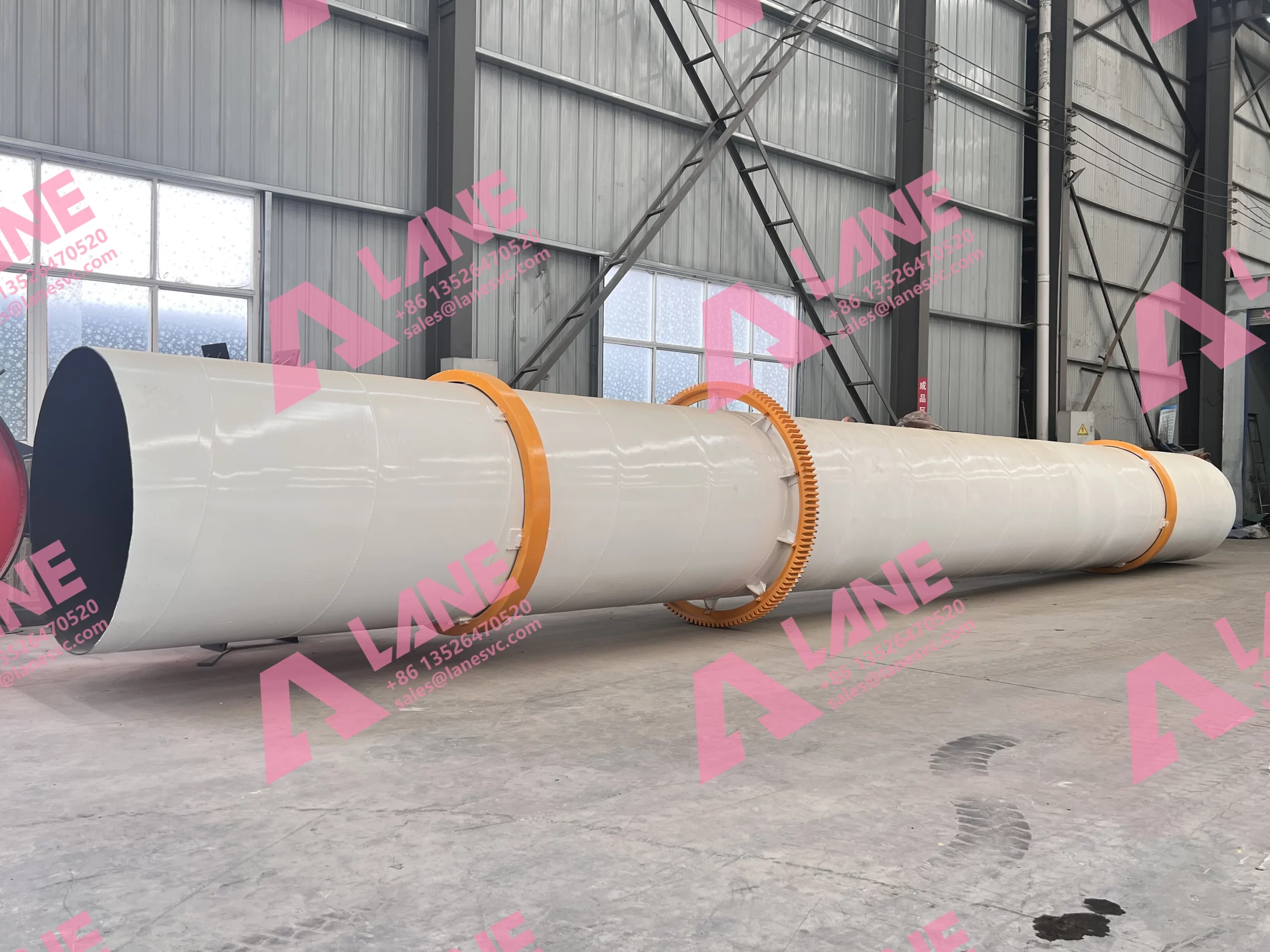
SOP (sulfate of potash) is a valuable potassium fertilizer used for crops that are sensitive to chloride. During fertilizer production, granulated SOP usually contains residual moisture that must be removed before the product can move to the next processing stage. If the granules are not dried properly, they may become sticky, form lumps during storage, or create problems during screening and packaging.
Choosing the right fertilizer dryer for SOP is therefore an important part of planning an SOP fertilizer production line. However, selecting a dryer is not simply a matter of matching the machine to the production capacity. The inlet moisture content, required final moisture, granule characteristics, heating source, and local fuel prices all affect the actual drying requirements.
For most granular fertilizer applications, a rotary drum dryer is a practical option. It works with a hot air system to remove moisture continuously, making it suitable for production lines that need stable and consistent output.
This guide explains how to select a fertilizer dryer for SOP, compare common drum sizes, choose a suitable heating source, and match a hot blast stove to the drying process.
What Should You Consider When Choosing a Fertilizer Dryer for SOP?
Before choosing a fertilizer dryer for SOP, collect several basic production details. These figures help determine how much heat the system needs and whether a standard rotary drum dryer can meet the production target.
Inlet moisture content
The moisture content of SOP granules entering the dryer is one of the most important factors. Granules with higher moisture require more heat and a longer drying process.
For example, a production line handling 5 tons of wet granules per hour does not necessarily need the same drying capacity as another 5 T/H line. If one line has an inlet moisture content of 8% and the other has 15%, the amount of water that must be removed will be different.
Target outlet moisture
You should also define the required moisture content after drying. A dryer must remove enough water to meet the downstream product requirements, but excessive drying wastes energy and may affect the physical quality of the granules.
The target should be based on the SOP product specification and actual production tests rather than an assumed universal value.
Actual hourly output
Use the amount of wet material entering the dryer, not only the final output of the production line. The dryer handles material before moisture has been removed, so its required feed capacity may be higher than the final dry product weight.
Granule size and physical strength
Small particles, large granules, and fragile particles may behave differently inside a rotary drum. The lifting plates, drum rotation, feeding rate, and drying conditions should be considered together to avoid uneven drying or unnecessary particle breakage.
These details provide a more reliable basis for selecting a fertilizer dryer for SOP than production capacity alone.
How to Choose the Right Rotary Drum Dryer Size?
A rotary drum dryer uses a rotating cylinder to move fertilizer granules through a heated drying zone. Lifting plates installed inside the drum repeatedly raise and release the material, allowing it to come into contact with the hot air.
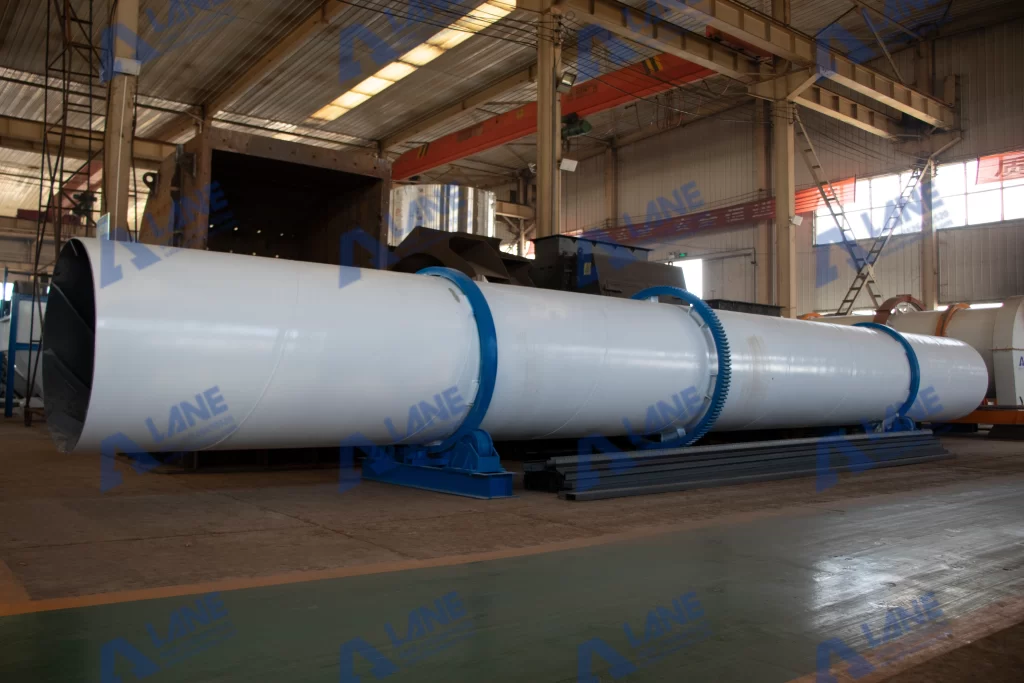
The drum size affects the amount of material that can be handled and the available space for heat exchange. A larger drum generally provides more internal volume, but the correct size still depends on the material’s moisture content, required evaporation rate, and operating conditions.
The following models are common reference options listed on the manufacturer’s rotary drum dryer product page.
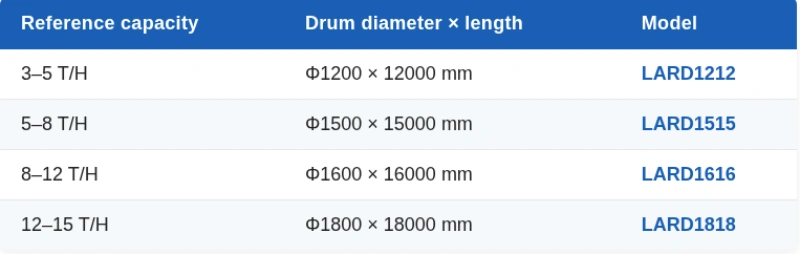
For a 3–5 T/H production line
The LARD1212 has a drum diameter of 1,200 mm and a length of 12,000 mm. It is a reference option for smaller production lines within the listed capacity range.
For a 5–8 T/H production line
The LARD1515 measures Φ1500 × 15000 mm. It provides a larger drum volume for production lines with higher feed rates.
For an 8–12 T/H production line
The LARD1616 measures Φ1600 × 16000 mm. It is a reference model for medium-scale drying requirements.
For a 12–15 T/H production line
The LARD1818 measures Φ1800 × 18000 mm. It is suitable as a reference option for a larger continuous production line.
These figures are the manufacturer’s listed model capacities, not guaranteed output figures for every SOP formulation. A fertilizer dryer for SOP should be selected after checking the actual inlet moisture, target outlet moisture, material properties, and available heating capacity.
For other models and detailed specifications, see the rotary drum dryer specifications.
Which Heating Source Is Suitable for a Fertilizer Dryer for SOP?
The heating source directly affects the operating cost and stability of a drying system. A rotary drum dryer needs a continuous supply of hot air, so the fuel should be selected according to local availability, price, and operating conditions.
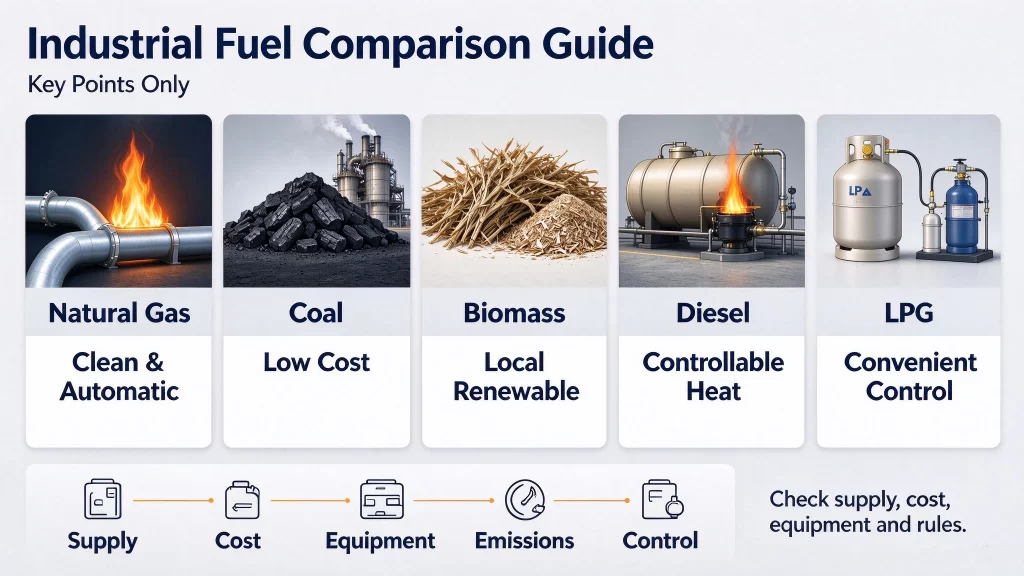
Natural gas
Natural gas is convenient where a reliable pipeline supply is available. Its combustion process is relatively easy to control, making it suitable for production lines that require stable hot air temperatures.
However, the local gas price and pipeline connection cost should be included in the investment calculation. Natural gas is not automatically the cheapest option in every country.
Coal
Coal may be an economical heating option in areas where it is readily available at a competitive price. It can provide a substantial amount of heat for continuous industrial drying.
The disadvantages include ash handling, combustion management, emissions control, and additional environmental requirements. Before choosing coal, check local regulations and the cost of the necessary dust and flue-gas treatment equipment.
Biomass
Biomass fuels, such as biomass pellets, may be suitable for factories located near agricultural or forestry residue suppliers. Their cost can be attractive when local resources are available.
However, biomass quality varies. Moisture content, particle size, and heating value can affect combustion stability. A consistent fuel supply is important if the fertilizer dryer for SOP needs to operate for long shifts every day.
Diesel
Diesel is relatively easy to store and can be useful where gas pipelines or other fuel supplies are unavailable. It can also provide a convenient heating option for certain production conditions.
Its main disadvantage is operating cost. For a plant running continuously, calculate the expected diesel consumption before choosing this option.
LPG
LPG can be considered where natural gas is unavailable but a gas-based heating system is preferred. It offers convenient combustion control, although storage, transportation, safety requirements, and fuel prices must be considered.
The best fuel is not necessarily the one with the lowest price per kilogram or cubic meter. Compare the estimated cost of evaporating one ton of water. This provides a more useful basis for evaluating different heating options.
How Does a Hot Blast Stove Work with a Rotary Drum Dryer?
A hot blast stove is an important part of a hot-air drying system. It produces the heated air required by the rotary drum dryer. The two machines perform different functions: the hot blast stove supplies heat, while the rotary drum dryer provides the space and material movement needed for drying.
In a typical arrangement, fuel is burned in the heating unit, and the generated heat is transferred to the air supplied to the dryer. Fans move the hot air through the system. Inside the rotating drum, lifting plates continuously turn the fertilizer granules so that they come into contact with the hot air.
When selecting a fertilizer dryer for SOP, the heating unit should be matched to the actual drying load rather than selected only by the drum’s nominal capacity.
For example, a line with a nominal feed rate of 5 T/H may use a different heating configuration depending on the moisture that must be removed. If the material enters the dryer with high moisture, the required heat load may be greater than that of a line handling drier material at the same feed rate.
A suitable fertilizer dryer for SOP therefore requires coordination between the drum, hot blast stove, fans, and air ducting. The final configuration should be confirmed using the actual material and process data.
How Should You Control the Drying Temperature for SOP?
Temperature control is important because the goal is to remove excess moisture without unnecessarily affecting the granules.
A higher hot-air temperature may increase the rate of moisture removal, but it does not mean that the highest possible temperature is always the best choice. The actual drying result also depends on air volume, material feed rate, residence time, and the amount of moisture entering the drum.
Check the inlet and outlet moisture
Measure the moisture content of the material before and after drying. If the outlet moisture remains too high, the problem may be insufficient heat, excessive feed rate, poor air distribution, or insufficient residence time.
Adjust the feed rate
If wet material enters faster than the system can dry it, the outlet product may not meet the moisture target. Reducing the feed rate can help identify whether the system is operating beyond its effective drying capacity.
Avoid unnecessary overheating
Excessive heat can increase energy consumption and may affect product quality. Temperature settings should be established through commissioning and adjusted according to actual operating results.
For a fertilizer dryer for SOP, stable operation is more useful than simply pursuing a high inlet temperature. The target is consistent outlet moisture with reasonable fuel consumption.
What Other Equipment Is Needed for the Drying Process?
A rotary drum dryer normally works with several auxiliary components. These parts help maintain material flow, hot-air circulation, and dust control.
Hot blast stove: Supplies the heat required for drying.
Blower and induced draft fan: Help move hot air and maintain the required airflow through the drying system.
Dust collection system: Collects dust carried by the exhaust gas and helps control emissions. The specific equipment should be selected according to local environmental requirements.
Conveyors: Transfer wet granules into the dryer and move dried material to the next processing stage.
Rotary cooler: Dried SOP granules may still be hot when they leave the dryer. Cooling them before storage and packaging helps prevent problems caused by packing hot material.
Cooling is a separate step after drying. When planning a fertilizer dryer for SOP, make sure there is enough space and suitable conveying equipment for the following process.
What Information Should You Prepare Before Buying a Fertilizer Dryer for SOP?
Before requesting a quotation, prepare the following information. It helps the manufacturer evaluate the required drum size, heating capacity, and auxiliary equipment.
- Required production capacity: How many tons of wet material need to be processed per hour?
- Inlet moisture content: What is the moisture content of the granules before drying?
- Target outlet moisture: What moisture level should the finished product reach?
- Granule size: What is the approximate particle size range?
- Available fuel: Can the factory obtain natural gas, coal, biomass, diesel, or LPG?
- Daily working hours: Will the dryer operate for 8, 16, or 24 hours per day?
- Installation conditions: What space, power supply, and environmental control facilities are available?
Providing these details makes it easier to determine whether a standard fertilizer dryer for SOP is suitable or whether the drying system needs a customized configuration.
It also helps avoid a common purchasing mistake: choosing a large drum without checking whether the heating system can supply enough energy to remove the required amount of water.
Conclusion
Choosing a suitable fertilizer dryer for SOP requires more than comparing machine dimensions or nominal production capacities. The inlet moisture content, target outlet moisture, hourly feed rate, fuel availability, and required heat input all influence the final selection.
A rotary drum dryer is a practical option for continuous SOP granule drying. Common reference sizes range from Φ1200 × 12000 mm to Φ1800 × 18000 mm for the 3–15 T/H capacity ranges listed above. The hot blast stove should then be selected according to the actual drying load, not simply matched by nominal production capacity.
If you are planning an SOP fertilizer production line, prepare your material moisture data, production target, and available fuel information before selecting a fertilizer dryer for SOP. These details will help determine a more suitable dryer size and heating configuration.

Write a Reply or Comment