
SOP Fertilizer Dust Control: Sources, Equipment and Practical Solutions
Why Is SOP Fertilizer Dust Control Important?
SOP fertilizer dust control is an important consideration when building, operating, or upgrading a potassium sulfate production plant. SOP, also known as sulfate of potash, is commonly manufactured through the Mannheim process, in which potassium chloride reacts with sulfuric acid at high temperatures to produce potassium sulfate and hydrogen chloride gas. After the reaction, the solid product moves through several handling stages, including cooling, crushing, screening, conveying, storage, and packaging. Dust may escape during these operations if the equipment and transfer points are not properly designed.
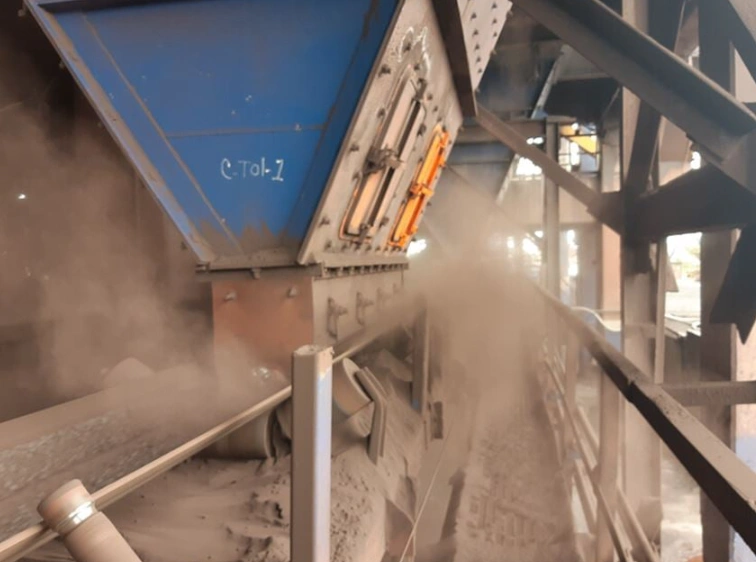
For fertilizer manufacturers, dust is not simply a cleaning problem. Fine particles escaping from the production line may represent a loss of finished product. Dust can also accumulate around machinery, enter electrical components, settle on floors and platforms, and increase the time required for routine cleaning. In areas where operators frequently handle dry materials, airborne particles may also affect the working environment.
The actual dust situation varies from one SOP plant to another. It depends on the physical form of the material, particle size, moisture content, temperature, production capacity, and material-handling method. A plant producing powder-grade potassium sulfate may face different dust problems from a plant handling larger crystals or processed granules. Therefore, SOP fertilizer dust control should be planned according to the actual production process rather than based on a standard equipment list.
Another important point is that not all emissions from an SOP production line are the same. Solid particles released during crushing or conveying are different from hydrogen chloride gas generated in the Mannheim furnace. These two materials require different collection and treatment methods. A baghouse dust collector, for example, is designed for suitable solid particles; it cannot replace an HCl gas absorption system.
A practical approach to SOP fertilizer dust control begins by identifying the locations where solid material becomes airborne. The next step is to determine how each location should be enclosed, where extraction points should be installed, and which filtration equipment is appropriate. This source-based approach helps manufacturers avoid purchasing equipment that does not match their actual production conditions.
Where Does Dust Occur in an SOP Fertilizer Production Line?
To understand SOP fertilizer dust control, it is useful to follow the material through a typical Mannheim-process production line. The process begins with raw material preparation and feeding, continues through high-temperature reaction and product cooling, and then moves into crushing, screening, conveying, and packaging. Not every stage produces the same amount of dust, so each area should be evaluated separately.
Raw Material Feeding and Handling
Potassium chloride is usually stored before being transferred into the production process. Depending on the plant layout, it may be unloaded from bags or bulk vehicles, placed into a storage hopper, and transported by conveyors or other feeding equipment. Fine or dry KCl particles can become airborne when material is poured, dropped, or transferred between equipment.
The main risk points for SOP fertilizer dust control are usually the unloading area, hopper inlet, conveyor loading point, and transfer chute. If these locations are open, falling material can push surrounding air outward and carry fine particles into the workshop. Repeated material movement may also create dust around storage and feeding equipment.
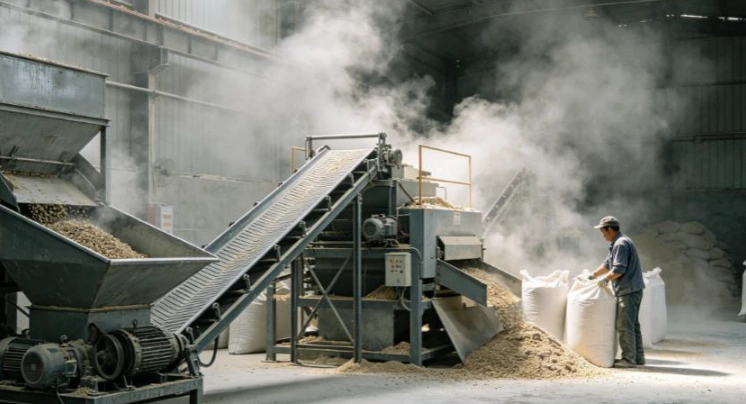
For this reason, SOP fertilizer dust control should begin at the raw material handling stage. Covered hoppers, enclosed conveyors, and local extraction hoods can help limit dust release. The design should reflect the physical form of the potassium chloride. Fine powder may require more attention than larger, free-flowing particles.
Mannheim Furnace Discharge and Product Cooling
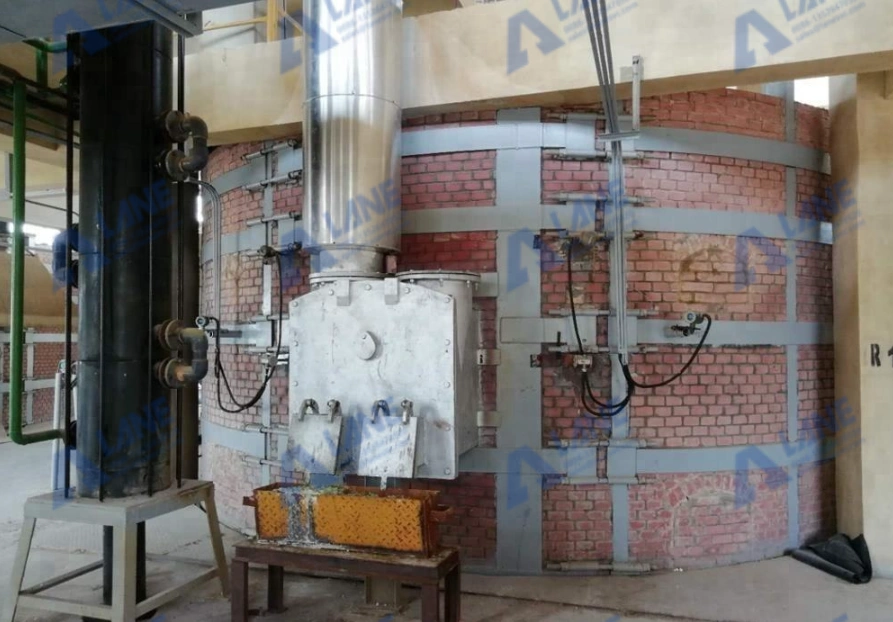
In the Mannheim process, potassium chloride and sulfuric acid react inside a high-temperature furnace. The resulting potassium sulfate leaves the reaction section as a hot solid product. It is then transferred to downstream equipment for cooling and further handling.
The chemical reaction itself should not be confused with ordinary mechanical dust generation, an important distinction when planning SOP fertilizer dust control around the Mannheim furnace. However, solid particles may become airborne when the product leaves the furnace, falls through a chute, or moves between the discharge equipment and cooler. The actual dust level depends on the product condition and the design of the discharge and transfer arrangement.
Cooling equipment also deserves attention because SOP fertilizer dust control must cover the points where hot solid material is discharged, cooled, and transferred. Material may break apart or release fine particles as it moves through the cooler and onto the next conveyor. A collection hood may be needed around suitable discharge or transfer points. However, the temperature of the material and the surrounding air must be checked before selecting the hood, ductwork, and filter. A standard dust collector should not receive air that exceeds its permitted operating temperature.
When planning SOP fertilizer dust control around the cooling section, manufacturers should consider both the location of the extraction point and the condition of the air entering the filtration system. If the air is too hot, additional cooling or a different collection arrangement may be required.
Crushing and Grinding
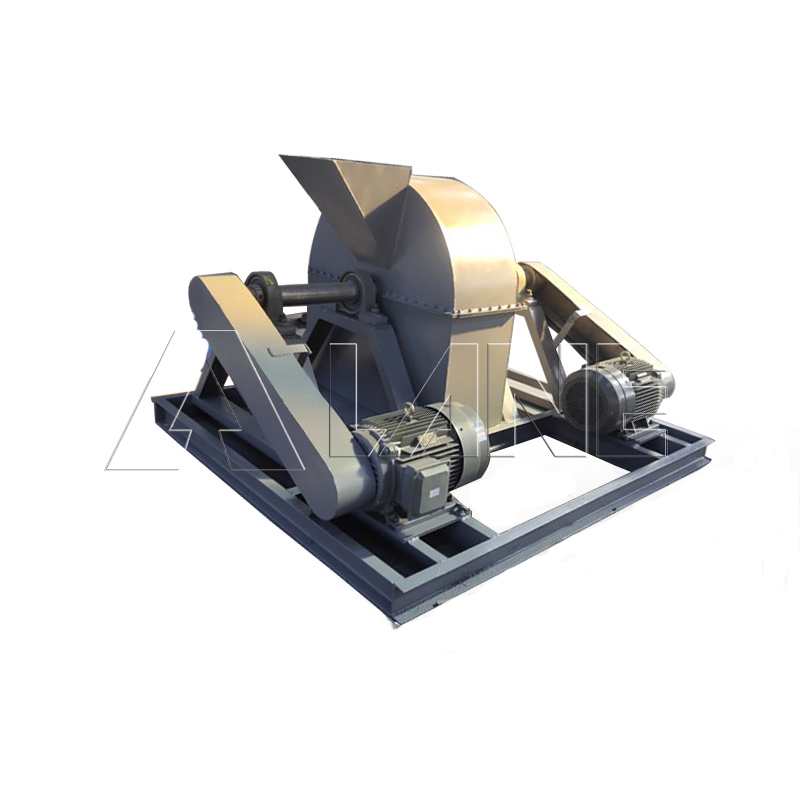
Crushing is one of the main areas to inspect in an SOP production plant because SOP fertilizer dust control is particularly important where solid material is broken into smaller particles. The solid product may contain lumps or oversized pieces that need to be reduced before screening. When these pieces are broken into smaller particles, fine material can become airborne around the crusher inlet, outlet, and connected conveyor.
A Cage Crusher may be used for suitable size-reduction duties, depending on the material characteristics and required product size. The machine should be selected according to the feed size, desired output, capacity, and product properties. Its inlet and discharge areas should also be considered when designing dust extraction.
A Ball Mill may be used when the process requires further grinding or a finer product, and SOP fertilizer dust control should be considered around its feeding and discharge points. However, a ball mill is not a mandatory machine in every Mannheim SOP production line. Whether it is needed depends on the required product specification and the selected process route. If grinding is included, the mill inlet, outlet, and material transfer points should be assessed as potential dust sources.
This is where SOP fertilizer dust control becomes closely connected with equipment selection. A crusher or mill should not be considered separately from its feeding, discharge, and extraction arrangements. An enclosed machine with properly positioned extraction points is generally easier to manage than an open machine surrounded by airborne dust.
For more information about the company’s fertilizer machinery and related equipment, readers can visit fertilizer machinery and equipment solutions.
Screening and Material Conveying
After crushing or other size-reduction operations, the material may enter a screening machine to separate particles according to the required size range, making this stage another important part of SOP fertilizer dust control.Vibration, particle impact, and repeated movement can release fine particles, especially when dry material falls onto the screen surface or moves through an open discharge chute.
Dust may escape from the screen feed opening, discharge points, and connections between the screen and conveyors. The conveyor system also contains several possible dust sources. These include loading points, belt transfer points, elevator discharge outlets, and locations where material falls into a storage bin.
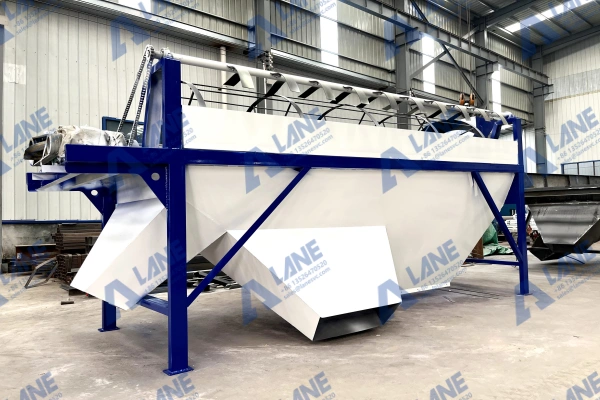
A practical SOP fertilizer dust control arrangement should therefore consider the entire material route instead of focusing only on the screening machine. Enclosing suitable sections, reducing unnecessary drop heights, and installing extraction hoods near important transfer points can help reduce dust spreading.
The material flow should remain smooth after adding enclosures and collection equipment. If a hood blocks the discharge or a cover makes inspection difficult, operators may remove it during production. The final design needs to balance dust capture, material movement, equipment access, and routine maintenance.
Finished Product Storage and Packaging
After screening, qualified SOP product is transferred to a finished-product bin or storage silo. It then moves to a weighing and packaging machine. Powder-grade products and fine crystals can release dust when they fall into bags, especially when the filling process displaces air from the bag.
The main collection points may include the storage-bin outlet, weighing hopper, bag-filling opening, and bag discharge area. Dust can also escape when bags are moved or when material remains around the packaging connection.
SOP fertilizer dust control at the packaging stage should focus on capturing particles close to the filling point. A suitable hood or enclosed filling station can collect displaced air before dust spreads through the workshop. The extraction arrangement must not interfere with weighing accuracy, filling speed, bag sealing, or the operator’s access to the machine.
Packaging is also a useful place to review the overall condition of the finished product. If the product contains excessive fines, dust may continue to appear even when the collection hood is properly installed. In that situation, the manufacturer should check upstream crushing, screening, and product-handling conditions instead of relying only on a larger dust collector.
SOP Fertilizer Dust Control: What Equipment Is Needed?
A complete SOP fertilizer dust control system is normally made up of several connected components. The purpose is to capture dust near its source, transport the dust-laden air through a duct network, and separate solid particles before the cleaned air is discharged or handled according to the plant’s requirements. Choosing one filter
without considering the rest of the system may lead to poor collection performance.
Dust Collection Hoods and Enclosures
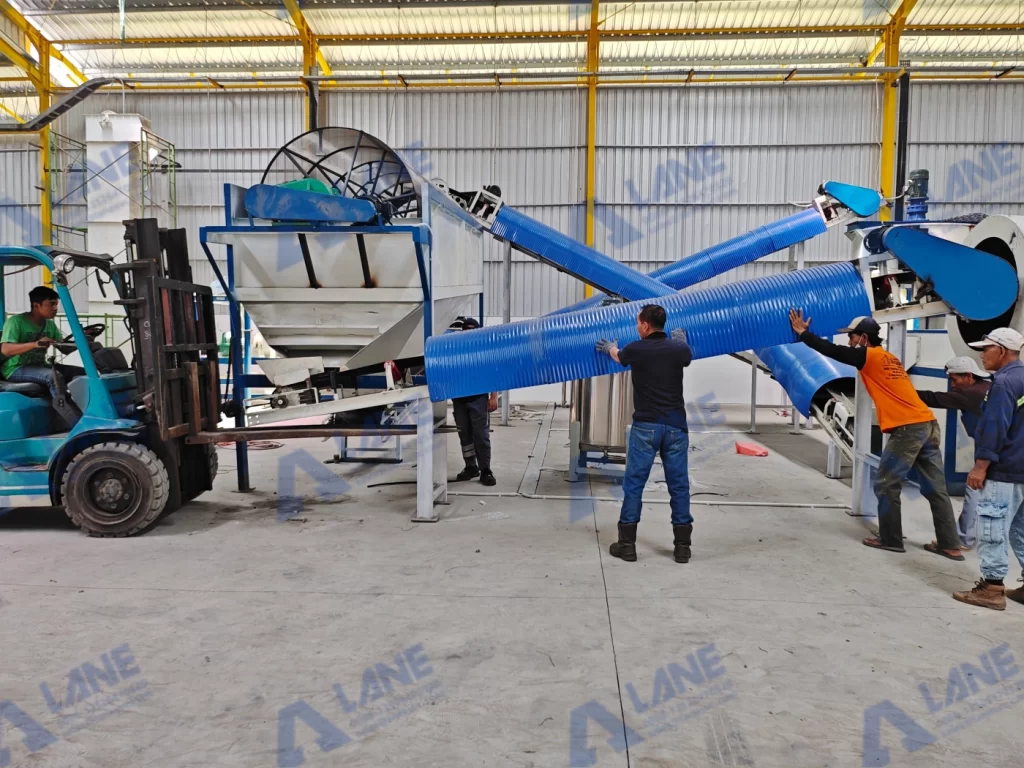
A dust collection hood captures airborne particles close to the point where they are generated. It can be installed around a crusher outlet, screening machine, conveyor transfer point, storage-bin opening, or bag-filling station.
The hood should be positioned according to the direction of material movement and the way dust is released. A hood installed too far from the source may fail to capture particles effectively. An opening that is too small may interfere with material movement, while an unsuitable design may make inspection and cleaning difficult.
Enclosures provide another way to control dust. They limit the space in which particles can spread and help guide airborne material toward an extraction point. In practice, a combination of partial enclosure and local extraction may be more suitable than relying on a large open hood.
Baghouse Dust Collectors
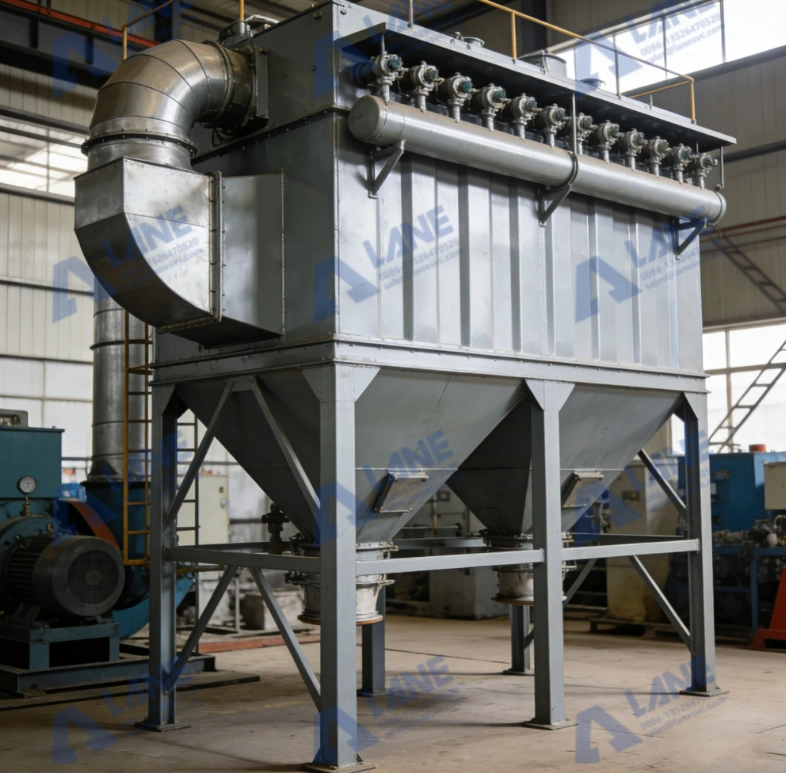
A baghouse dust collector separates solid particles from an air stream by passing the air through filter bags. Dust collects on the filter surface, while cleaned air passes through the filtration unit. A cleaning mechanism removes accumulated dust from the bags, and the collected material is discharged into a hopper or other collection device.
Baghouse filters can be suitable for many dry solid-fertilizer dust applications. However, the filter media and operating conditions must match the actual dust characteristics. Temperature, moisture, particle size, chemical properties, airflow, and the possibility of condensation should all be considered.
For SOP fertilizer dust control, a baghouse should be selected according to the amount of air that needs to be treated and the dust-loading conditions. The filter area, air-to-cloth ratio, cleaning method, hopper design, and dust discharge arrangement all affect the system’s operation. A collector that is too small may experience high pressure loss or frequent cleaning requirements. A collector that is unnecessarily large may increase equipment and operating costs.
Cyclone Dust Collectors
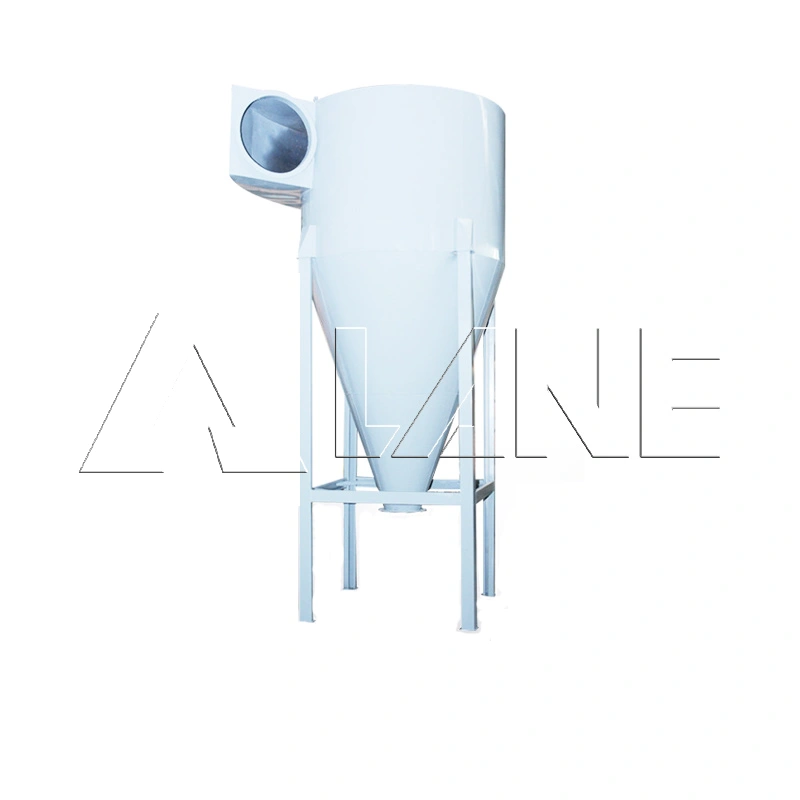
A cyclone dust collector uses centrifugal action to separate particles from an air stream. The incoming air follows a rotating path, causing suitable particles to move toward the cyclone wall and fall into the collection section.
Cyclones are often considered when the air contains larger or heavier particles. They may be installed before a baghouse to reduce the dust load entering the filter. Their actual separation performance depends on particle size, density, airflow, and cyclone design.
A cyclone should not automatically be treated as a complete solution for fine SOP dust. If very small particles remain in the air, a downstream filtration unit may still be necessary. The equipment combination should be selected according to the required collection efficiency and the characteristics of the dust.
Industrial Exhaust Fans and Ductwork
The exhaust fan provides the airflow needed to draw dust-laden air from the collection hoods toward the dust collector. Ductwork connects the different collection points and transports the air through the system.
The duct network should be designed according to the number of extraction points, required airflow, pipe diameter, length, bends, and operating conditions. Poorly designed ductwork may create excessive pressure loss or allow particles to settle inside the pipes. If airflow is not balanced, some collection hoods may work well while others provide insufficient capture.
For effective SOP fertilizer dust control, the fan, hoods, ducts, and filter should be treated as one integrated system. Selecting each component independently without checking the complete airflow path can lead to poor performance, unnecessary energy consumption, or difficult maintenance.
Dust Discharge and Collection Equipment
The dust separated by the filter must be removed from the collector in a controlled way. Depending on the design, the system may use a sealed hopper, rotary valve, screw conveyor, or another suitable discharge arrangement.
The collection equipment should prevent dust from escaping again during discharge. If recovered SOP fines are intended for reuse, their composition, contamination level, and effect on product quality must be checked first. Not all collected material should automatically be returned to the production process.
How to Design an Effective Dust Collection System for an SOP Plant?
An effective SOP fertilizer dust control system should be designed around the actual production layout. The objective is not simply to install a large dust collector, but to capture particles at the source and transport them through a suitable collection network.
Identify the Main Dust Sources
The first step is to prepare a process layout showing raw-material feeding, furnace discharge, cooling, crushing, screening, conveying, storage, and packaging. Mark the locations where dry material falls, breaks, or changes direction. These points are useful starting locations for evaluating extraction requirements.
The plant should also record which machines operate at the same time. This information helps determine how many collection points may be active simultaneously and how much airflow the system needs to provide.
Set Up Collection Points
After identifying the main dust sources, the next step is to select suitable hood and enclosure locations. Crushing and screening areas often deserve particular attention because mechanical impact and vibration can release fine particles. Packaging areas may need separate collection points because the air displaced during bag filling can carry dust out of the opening.
The hood should be close enough to capture particles without blocking material movement or maintenance access. For transfer points, reducing the material drop height and enclosing the chute can also help limit dust release.
Calculate the Required Airflow
Airflow requirements depend on the hood design, opening size, dust generation, and number of collection points operating at the same time. The fan and ductwork should be calculated as part of the complete system.
Simply choosing a more powerful fan does not guarantee better dust collection. Excessive or poorly distributed airflow can increase energy use without solving problems caused by incorrect hood placement or duct resistance. The system needs a balanced airflow arrangement that provides suitable capture at each operating point.
Select the Filtration Equipment
The filtration method should match the characteristics of the dust and the condition of the air. A cyclone may be useful for removing larger particles, while a baghouse may be selected for further filtration of suitable dry dust. In some applications, the two may be combined.
Filter media should be compatible with the actual operating temperature, moisture, and chemical conditions. If the process air contains corrosive substances or has a high temperature, additional engineering evaluation is needed before choosing the filter and duct materials.
Plan Dust Discharge and Maintenance
A dust collection system also needs a practical method for removing collected material. The hopper, discharge valve, and conveying equipment should be designed to prevent blockages and secondary dust release.
Routine inspection is equally important. Operators should check filter bags, cleaning mechanisms, fan performance, duct deposits, and connections around the collection hoods. A system that is correctly selected but poorly maintained may gradually lose its collection performance.
For manufacturers planning a complete potassium sulfate facility, SOP fertilizer dust control should be considered during the production-line design stage. The position of crushers, screens, conveyors, storage bins, and packaging machines affects the length and layout of the duct network. Planning these systems together can reduce later modifications and make equipment maintenance easier.
Companies evaluating a complete SOP project can also review the available fertilizer production line solutions to understand how individual processing sections can be coordinated within a larger plant layout.
Dust Control and HCl Gas Treatment in SOP Production
Dust collection and hydrogen chloride treatment are two different environmental-control tasks in a Mannheim SOP plant. Although both may involve air-handling equipment, they deal with different substances and require different treatment methods.
Solid Dust from Material Handling
Solid dust may come from potassium chloride feeding, solidified potassium sulfate discharge, crushing, grinding, screening, conveying, and packaging. These particles can be collected through hoods and ductwork and treated with a suitable cyclone or baghouse system.
The equipment must be selected according to the dust characteristics and the temperature and moisture of the air. The collection points should be positioned near the actual sources rather than relying on general workshop ventilation to remove dust after it has spread.
HCl Gas from the Mannheim Reaction
Hydrogen chloride is generated during the reaction between potassium chloride and sulfuric acid in the Mannheim furnace. It is an acidic process gas, not ordinary fertilizer dust. Therefore, it requires a dedicated gas collection and absorption arrangement.
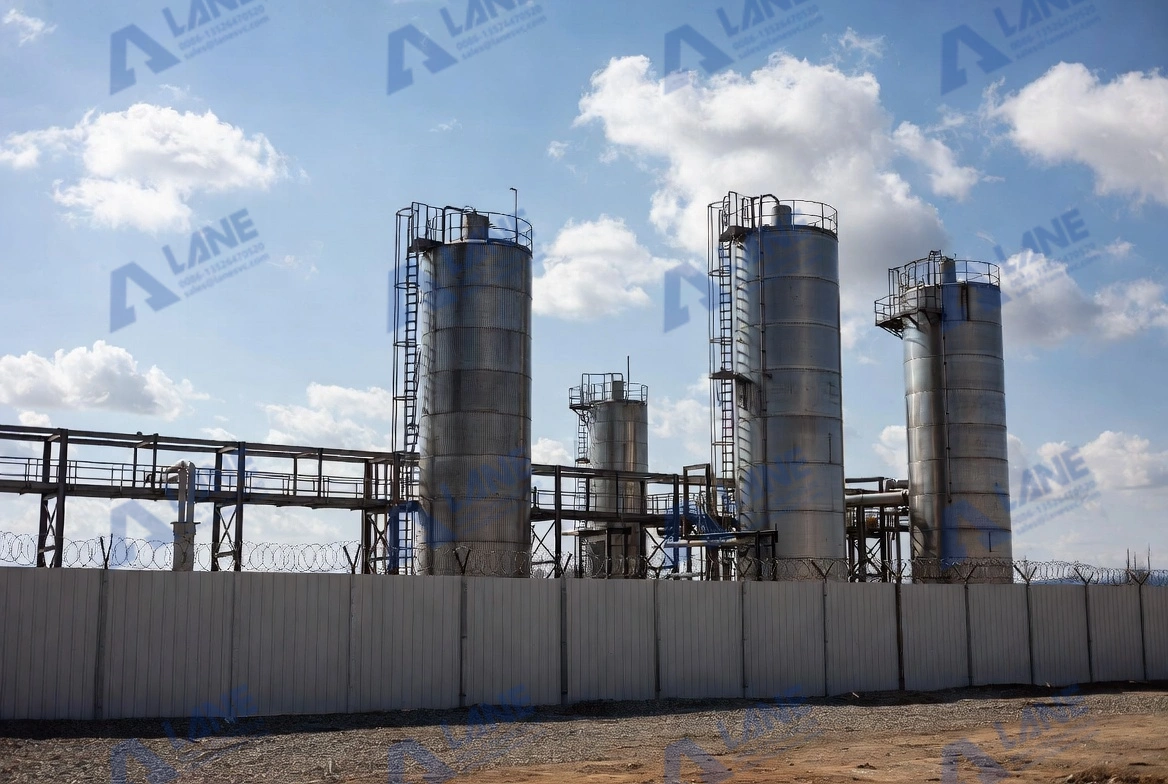
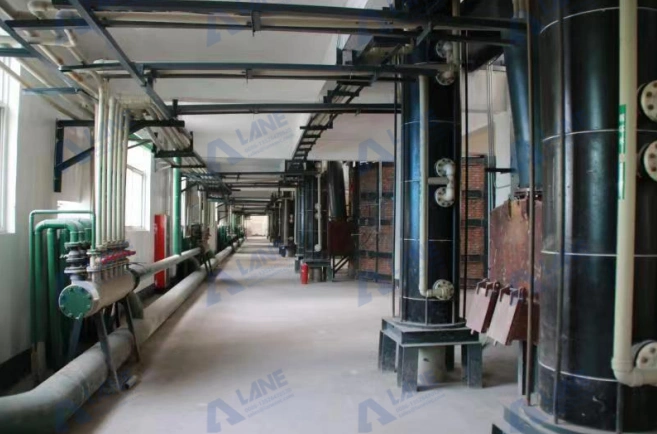
Depending on the process design, the system may include corrosion-resistant ducts, gas cooling equipment, absorption towers, acid circulation equipment, storage tanks, and downstream treatment facilities. Materials must be suitable for the corrosive operating environment.
A spray tower may be used in a gas-treatment system when its design, internal components, and construction materials are suitable for the gas composition and operating conditions. However, it should not be described as a direct replacement for a baghouse dust collector. The two devices perform different functions.
Why These Two Systems Must Be Evaluated Separately
A baghouse dust collector is designed to separate suitable solid particles from an air stream. It is not a substitute for equipment designed to absorb hydrogen chloride gas. Likewise, an HCl absorption tower does not automatically provide effective dust capture at a crusher, screen, or packaging machine.
This distinction is particularly important when planning SOP fertilizer dust control for a Mannheim plant. If solid dust and acidic gas are treated as the same problem, the selected equipment may not match the actual process requirements. The plant should evaluate the dust collection system and the HCl treatment system separately, while coordinating their layouts and operating requirements.
Frequently Asked Questions About SOP Fertilizer Dust Control
Q:Which stages of SOP production generate the most dust?
A:Crushing, grinding where required, screening, conveying, and packaging are important areas to inspect. Raw-material unloading and feeding may also generate dust, depending on particle size, moisture, and handling conditions. The actual dust level should be evaluated at each plant rather than assumed to be identical across all production lines.
Q:Can a baghouse dust collector be used in an SOP plant?
A:Yes. A baghouse may be suitable for collecting dry solid particles from selected production points. However, the filter media, operating temperature, moisture level, dust properties, airflow, and cleaning method must be checked before selecting the equipment.
Q:Can collected SOP dust be reused?
A:It may be possible to reuse some collected material, but this decision depends on its chemical composition, contamination level, and effect on the finished product specification. The collected dust should be tested and evaluated before being returned to the process.
Q:Does an SOP plant need both a dust collector and an HCl scrubber?
A:A Mannheim-process plant generally needs separate arrangements for solid dust and HCl process gas. The dust collection system handles particles released during material handling, while the HCl treatment system handles acidic gas from the reaction. The final configuration depends on the plant design and applicable emission requirements.
Q:Should dust collection equipment be installed on every machine?
A:Not necessarily. The collection points should be selected according to the actual dust sources, equipment enclosure, material flow, and operating conditions. Some machines may need local extraction, while several nearby points may be connected to a shared collection system if the airflow and duct design are suitable.
Q:How can a manufacturer reduce dust before installing a collector?
A:Good material handling can reduce the amount of dust released in the first place. Enclosing transfer points, avoiding unnecessary drop heights, maintaining suitable conveyor conditions, and preventing material leakage can all help. These measures should be considered alongside the main filtration equipment.
A reliable SOP fertilizer dust control plan is not based on installing one large collector in the workshop. It begins with identifying the actual dust sources, understanding the material-handling process, and selecting suitable collection points. The hoods, enclosures, ducts, fans, and filtration equipment must then be designed to work together.
When SOP fertilizer dust control is considered during plant planning, manufacturers can reduce avoidable product loss, improve housekeeping, and make the production environment easier to manage. The most suitable solution depends on the production capacity, product form, equipment arrangement, and dust characteristics of each factory.
For further equipment and production-line information, manufacturers can visit LANE’s official website, or explore the company’s fertilizer equipment and production solutions. Providing the planned capacity, raw material characteristics, product size, and plant layout will help an engineering team evaluate a suitable production and dust collection arrangement.




Write a Reply or Comment