
How to Produce High-Concentration NPK 15-15-15 Fertilizer: A Step-by-Step Guide
How to Produce High-Concentration NPK 15-15-15 Fertilizer: A Step-by-Step Guide
In the modern agricultural landscape, farmers are seeking nutrient profiles to ensure crop resilience and high yields. It is essential for achieving high crop yields. Among the various formulations available, NPK 15-15-15 stands out as a “universal” fertilizer. This fertilizer provides equal amounts of nitrogen, phosphorus, and potassium. For fertilizer manufacturers, learning how to produce high-concentration NPK 15-15-15 efficiently and consistently is key to staying competitive in both domestic and international markets.
However, to produce high-concentration NPK 15-15-15 that is stable, uniform, and easy to apply, you need more than just raw materials; you will need a production line which is precisely engineered, durable and can handle the corrosive raw materials of the production line. This comprehensive guide walks you through the complete process of how to produce high-concentration NPK 15-15-15 fertilizer using advanced production line equipment from LANE Heavy Industry.
Understanding NPK 15-15-15 Fertilizer
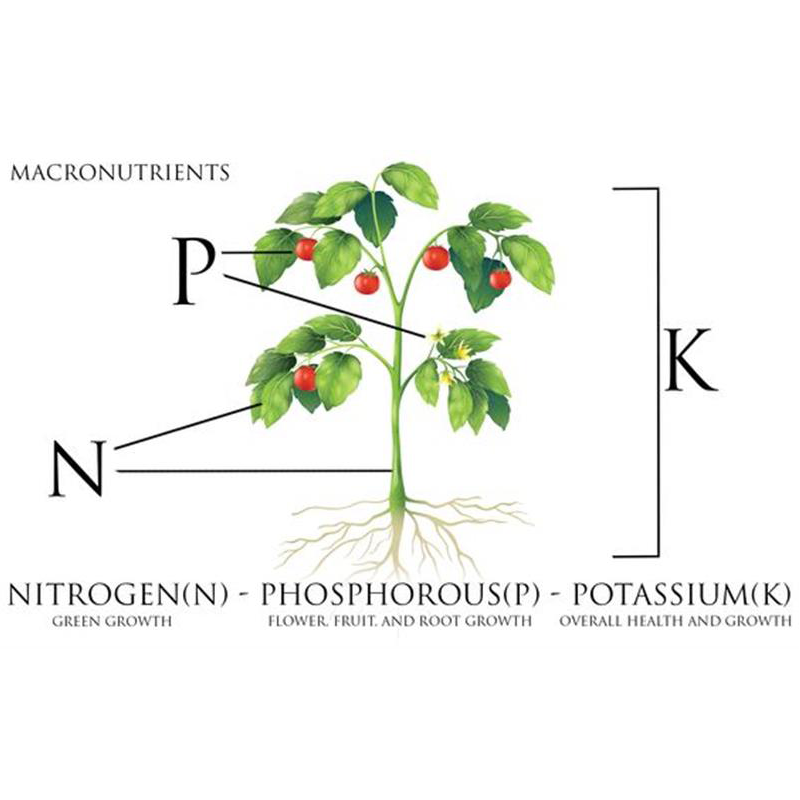
It is important for manufacturers to know what their fertilizer offers before they produce it. The NPK 15-15-15 is a unique fertilizer which contains:
- 15% Nitrogen (N): Promotes leaf and stem growth and makes the leaf more vibrant green color.
- 15% Phosphorus (P₂O₅): It is known as the quality element. Phosphorus enhances root development and flowering.
- 15% Potassium (K₂O): Improves disease resistance and fruit quality. While potassium doesn’t directly change the DNA of the tree, it helps the tree function properly.
To produce high-concentration NPK 15-15-15, manufacturers must carefully control raw material ratios and ensure uniform granulation.
Raw Materials Required
To successfully produce NPK 15-15-15, the following raw materials are typically used:
- Urea or ammonium nitrate (Nitrogen source)
- Monoammonium phosphate (MAP) or diammonium phosphate (DAP)
- Potassium chloride (MOP) or potassium sulfate (SOP)
- Fillers (if needed)
- Additives (anti-caking agents, trace elements)
Precise formulation is critical when you are aiming to produce high-concentration NPK 15-15-15. A slight mistake can change the nutrient balance. The production line must have the capability of precision measurements.
Step-by-Step Production Process
- Raw Material Crushing, Accurate Batching and Proportioning
The first step of production is collecting the raw materials and keeping them in separate storage areas to avoid contamination. After that the raw material should be conveyed to the automatic batching system. This machine accurately weighs the product according to the 15-15-15 formula.
Precision here is essential to produce high-concentration NPK 15-15-15 to ensure each granule contains the correct nutrient ratio.
Large raw material particles must be crushed into fine powder to ensure uniform mixing. A chain crusher or hammer crusher is used in this stage. Efficient crushing is the first step to produce high-concentration NPK 15-15-15, as particle size directly affects granulation quality.
The powdered raw materials are fed into a horizontal or double-shaft mixer. Uniform mixing ensures that every granule contains the exact same amount of nutrients. Without proper mixing it is impossible to produce premium NPK 15-15-15 with consistent quality.
Granulation is the core step of this process. LANE Heavy Industry offers several granulation technologies:
- Rotary drum granulator
- Double roller extrusion granulator
- Disc granulator
- For lower to medium production lines with limited budget, Double roller granulator is preferred because it allows manufacturers to produce high-concentration NPK 15-15-15 without requiring drying. For industrial-grade production lines, rotary drum granulator is preferred for its high capacity, shape, controllability and higher granulation rate.
- Drying (if applicable)
If wet granulation is used, the granules must be dried before they can move on to the next stage. The rotary drum dryer is used to reduce moisture content.
Drying helps stabilize the granules and is critical to produce high-concentration NPK 15-15-15 that can be stored and transported safely.
- Cooling
After drying, the granules are cooled in a rotary cooler to prevent caking and maintain structural integrity. Cooling strengthens the granules and ensures that the final product meets standards when you produce high-concentration NPK 15-15-15.
A rotary screening machine separates qualified granules from oversized or undersized particles.
- Qualified granules proceed to packaging
- Unqualified ones are recycled
Screening improves product uniformity and helps maintain consistency when you produce high-concentration NPK 15-15-15.
- Coating
To prevent caking and to add controlled-release function, granules may be coated with anti-caking agents. This step enhances the market value of products when you produce high-concentration NPK 15-15-15.
Finally, the finished fertilizer is packed using an automatic packaging machine.
Proper packaging ensures that when you produce high-concentration NPK 15-15-15, the product reaches customers in optimal condition.
Key Equipment in the Production Line
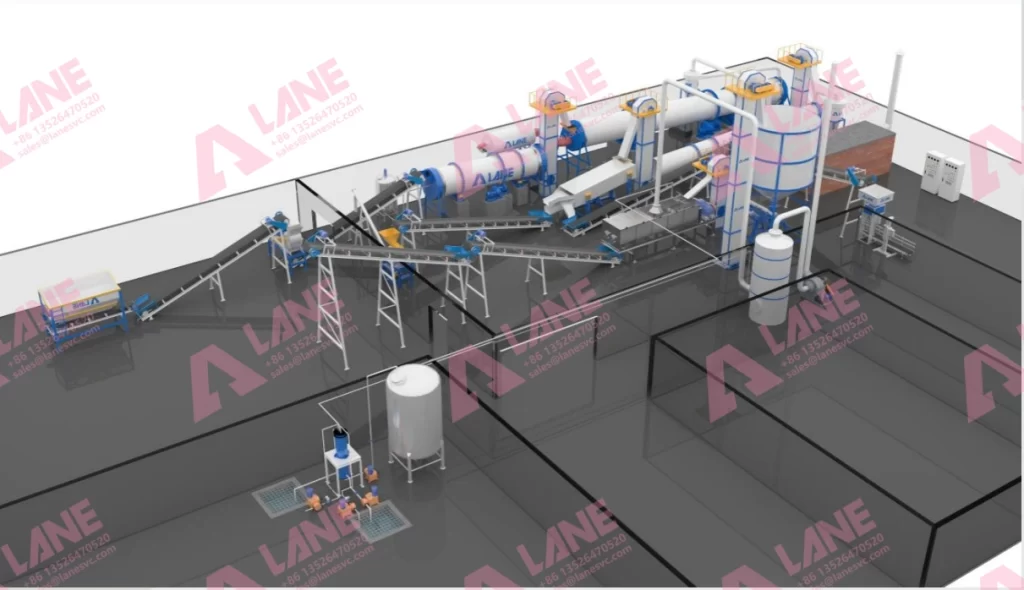
LANE Heavy Industry, a leader in the fertilizer machinery manufacturing industry, has engineered an efficient, precise and durable NPK production line which can produce high-concentration NPK 15-15-15. A complete production line from LANE Heavy Industry includes:
- Crusher
- Automatic batching system
- Mixer
- Granulator
- Rotary dryer and cooler
- Screening machine
- Coating machine
- Packaging machine
- Belt conveyors and dust collectors
The integrated equipment allows manufacturers to efficiently produce high-concentration NPK 15-15-15 on a large scale.
Advantages of Using LANE Production Line
Choosing LANE Heavy Industry equipment provides several advantages:
- High automation reduces labor costs
- Stable performance ensures consistent product quality
- Flexible design supports different formulas
- Energy-efficient systems lower operational costs
These advantages make it easier for businesses to produce high-concentration NPK 15-15-15 with high profitability.
Quality Control Measures
To consistently produce high-concentration NPK 15-15-15, strict quality control is necessary:
- Monitor raw material purity
- Ensure precise batching ratios
- Maintain proper moisture levels
- Test final product nutrient content
The manufacturer must perform laboratory testing and process monitoring. It is essential to guarantee that you successfully produce high-concentration NPK 15-15-15 that meets international standards.
Environmental Considerations
Modern fertilizer production must comply with environmental regulations. LANE systems include:
- Dust collection systems
- Waste gas treatment
- Noise reduction design
Sustainable practices not only protect the environment but also improve the efficiency of your production line.
Conclusion
The journey to produce high-concentration NPK 15-15-15 is a balance of chemistry and mechanical engineering. From intelligent batching, uniform mixing, high-quality granulation, drying-cooling, screening, recycling to anti-caking coating and automatic packaging, LANE Heavy Industry’s integrated fertilizer production line builds a complete industrial closed loop.
By utilizing a high-performance production line from LANE Heavy Industry, manufacturers can ensure that their final product is nutrient-dense, physically stable, and market-ready.
The production of high-concentration NPK 15-15-15 requires the right machinery which can precisely and consistently produce the granules. The right machinery is the foundation of your success when producing fertilizer.
Frequently Asked Questions (FAQ)
Q1: What does “high-concentration NPK 15-15-15” actually mean?
A1: It means the fertilizer contains a minimum of 40% total nutrients by weight, with equal parts of Nitrogen (N), available Phosphate (P₂O₅), and soluble Potash (K₂O), each at 15%. This balanced, high-analysis formulation is highly efficient and widely used across agriculture.
Q2: What is the typical production capacity of a LANE Heavy Industry NPK fertilizer production line?
A2: LANE’s production lines are highly customizable, with capacities ranging from 0.5 tons per hour to 100 tons per hour, allowing them to serve both small-scale manufacturers and large industrial operations.
Q3: What kind of after-sales support does LANE Heavy Industry offer?
A3: LANE provides comprehensive support, including a five-year warranty, free granulation experiment services, professional overseas installation, and ongoing after-sales service to ensure smooth and continuous operation
Of course, we also offer other types of products for your different needs, you can click to view.
For more information, please contact us by sending an inquiry today! We can help you!



Write a Reply or Comment