
Advanced NPK Organic Compound Production Technology for Sustainable Agriculture
Introduction
Modern agriculture faces the challenges of increasing crop yield while protecting soil health and the environment. It also faces the challenge of feeding 10 billion people by 2050. This has driven rapid innovation in fertilizer manufacturing, particularly in NPK organic compound production technology. NPK compound organic fertilizer combines essential nutrients—nitrogen (N), phosphorus (P), and potassium (K)—with organic matter. This smart fertilizer delivers balanced nutrition while improving soil structure and microbial activity. LANE Heavy Industry has played a significant role in advancing fertilizer production lines that make this technology efficient, scalable, and environmentally responsible.
When produced by the turnkey solutions from Henan LANE Heavy Industry Machinery Technology Co., Ltd., the NPK organic compound production technology is a practical, scalable reality for farms, cooperatives, and industrial producers worldwide. Our machinery integrates automation, precision control, and energy-efficient processes to enable producers to meet the rising global demand for sustainable fertilizers.
What Is NPK Organic Compound Production Technology?
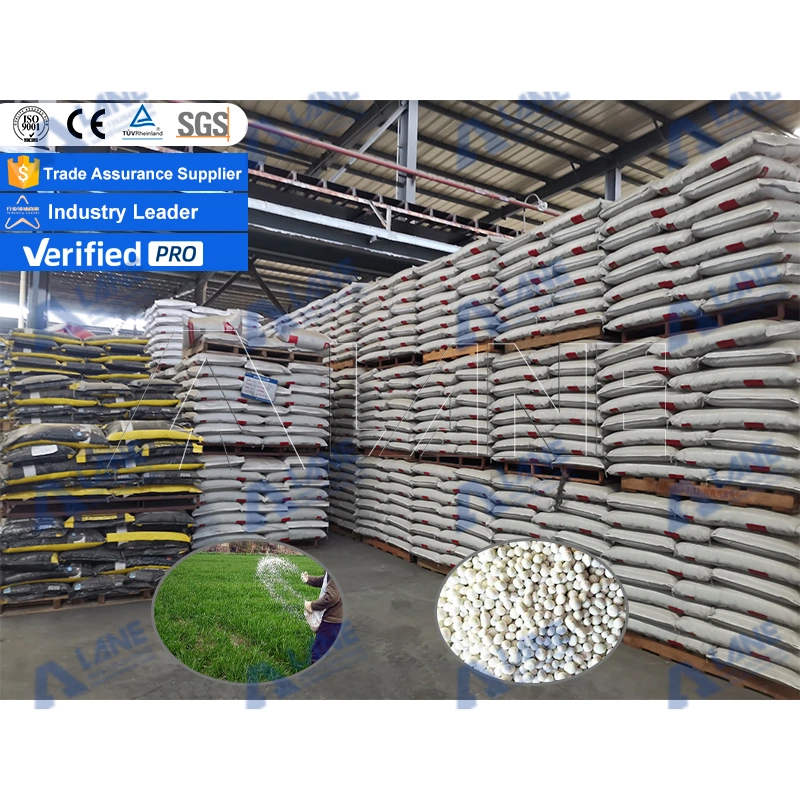
NPK organic compound production technology refers to the manufacturing process of blending inorganic NPK nutrients with organic materials such as compost, manure, or bio-waste. The goal of this production technology is to produce a compound fertilizer that offers both immediate nutrient availability and long-term soil benefits.
Unlike traditional chemical fertilizers, these compounds:
- Improve soil fertility over time
- Enhance water retention and aeration
- Support beneficial microbial activity
- Reduce nutrient leaching and environmental pollution
NPK organic compound production technology bridges the gap between organic farming and high-efficiency agriculture. This has the potential to be the future cornerstone of sustainable food production.
Role of LANE Heavy Industry’s Machinery
LANE Heavy Industry has engineered a modern NPK organic compound production technology specifically for sustainable agriculture. Our machines are engineered for reliability, flexibility, and high output.
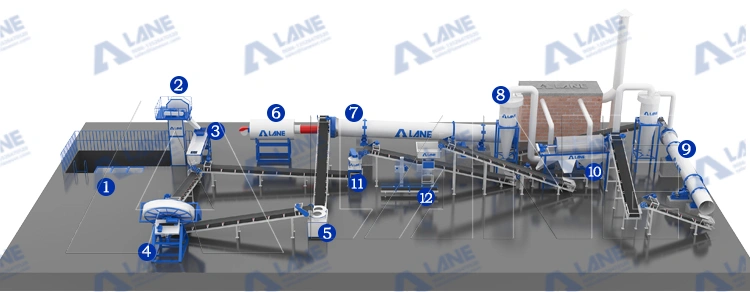
Key equipment in our production line includes:
- Raw material crusher: Our vertical crusher and chain crusher break down organic and mineral inputs into uniform particle sizes.
- Mixing system: LANE’s vertical crushers ensure precise blending of NPK nutrients with organic materials and micronutrients.
- Granulator: Our rotary drum granulator, disc granulator, and stirring pin granulator form uniform granules with consistent nutrient ratios and are adjustable.
- Rotary Drum Dryer and Cooler: Reduces moisture and temperature to improve storage stability and prevent clumping.
- Screening machine: Our rotary screening machine and vibrating screener separate qualified granules from oversized or undersized particles.
- Coating machine: Applies protective layers, nutrients, or both to improve nutrient release control.
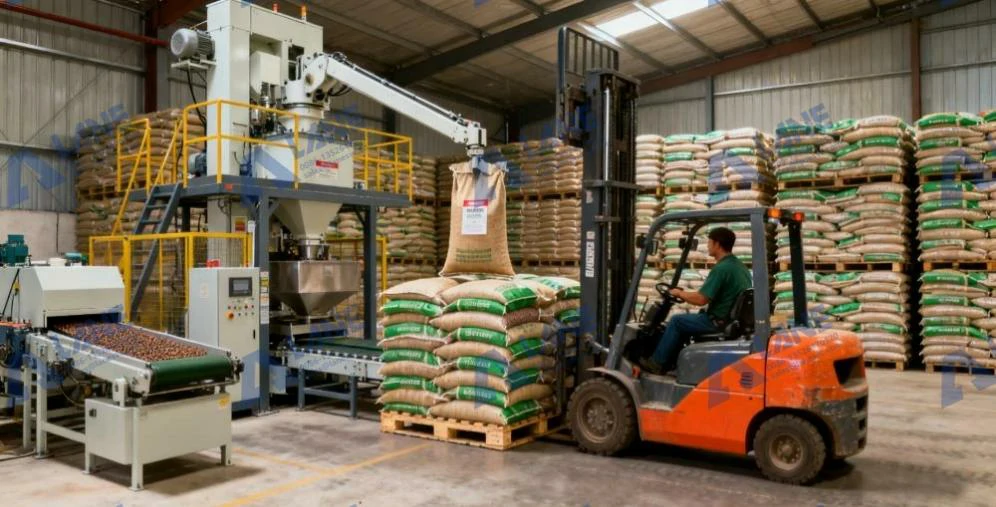
- Packaging system: LANE packing system automates final product handling for efficiency.
This integrated setup allows manufacturers to produce high-quality fertilizer at scale while minimizing waste and energy consumption.
Production Process Overview
The process of producing NPK organic compound fertilizer using advanced technology typically follows several stages:
- Raw Material Preparation: Organic materials such as compost or animal manure are pre-treated and crushed. Inorganic nutrients like urea, ammonium phosphate, and potassium chloride are also prepared.
- Proportioning and Mixing: Accurate ratios of N, P, K, and organic matter are calculated based on crop requirements. LANE’s automated batching systems ensure consistency in every batch.
- Granulation: The mixed materials are fed into a granulator, where they are shaped into uniform particles. This step is crucial for improving fertilizer handling and application efficiency.
- Drying and Cooling: Granules are dried to reduce moisture content and then cooled to stabilize their structure. This prevents caking during storage and transportation.
- Screening and Recycling: Particles are screened to ensure size uniformity. Oversized or undersized granules are recycled back into the process.
- Coating and Packaging: A protective coating may be applied to control nutrient release rates. The final product is then packaged for distribution.
Innovations Driving the Technology
LANE engineers with their two decades of experience have created and integrated newer designs into the NPK organic compound production technology. These designs and new machines have improved the efficiency and sustainability of NPK organic compound fertilizer. Key innovations include:
- Intelligent control systems that monitor temperature, humidity, and nutrient ratios in real time
- Energy-efficient drying systems that reduce fuel consumption and emissions
- Advanced granulation techniques that produce stronger, more uniform particles
- Integration of bio-organic additives to enhance soil microbial activity
- Waste recycling systems that convert agricultural residues into valuable inputs
LANE Heavy Industry incorporates many of these innovations into their machinery, making their production lines highly competitive in global markets.
Environmental and Economic Benefits
Adopting advanced NPK organic compound production technology offers multiple advantages:
Environmental benefits:
- Reduced chemical runoff and groundwater contamination
- Lower greenhouse gas emissions compared to traditional fertilizer production
- Improved soil biodiversity and long-term fertility
Economic benefits:
- Higher crop yields and better product quality
- Reduced dependency on chemical fertilizers
- Cost savings through efficient production and resource utilization
For fertilizer manufacturers and investors, investing in modern production lines from LANE Heavy Industry can lead to faster return on investment due to improved operational efficiency.
Applications in Modern Agriculture
NPK organic compound fertilizers can be used across various agricultural sectors:
- Field crops such as rice, wheat, and corn
- Horticulture including fruits and vegetables
- Greenhouse cultivation systems
- Organic farming operations with selective organic NPK raw materials
This fertilizer is valuable in regions where soil fertility and soil degradation are a concern. NPK organic compound production technology helps restore soil health while maintaining productivity.
Future Outlook
The future of NPK organic compound production technology is tied to environmental regulations and sustainability goals. Governments all over the world are pushing for greener agricultural practices. This is increasing the demand for organic-based fertilizers.
Emerging trends include:
- Smart fertilizer systems with controlled-release mechanisms
- Integration with precision agriculture technologies
- Increased use of renewable energy in production processes
- Development of customized nutrient formulations for specific crops
LANE Heavy Industry already has implemented fertilizer plants with the above technology. We are already moving forward towards greener technology so that manufacturers don’t have to face problems with future regulations.
FAQ
Q1: What raw materials are suitable for LANE’s NPK organic compound production technology?
A1: The lines adapt to diverse organic and inorganic materials. Organic inputs include fermented animal manure (chicken, cow, sheep), crop straw, sludge, and food waste. Inorganic inputs include urea, ammonium nitrate, MAP, DAP, potassium chloride, and potassium sulfate.
Q2: What is the production capacity range of LANE’s NPK organic compound lines?
A2: Capacities are customizable from 1 ton per hour (small-scale) to 50 tons per hour (large industrial), with modular designs for easy expansion.
Q3: How does LANE’s technology ensure environmental compliance?
A3: Closed-loop systems with dust collection, gas scrubbing, and waste heat recovery eliminate emissions. No wastewater discharge meets EU, CE, and ISO 9001 standards.
Q4: What is the granule quality of fertilizers produced by LANE’s lines?
A4: Granules are spherical (1–5mm), with strength ≥30N, moisture 2–4%, and uniform nutrient distribution. Granulation ratio reaches 90%, with minimal breakage.
Q5: Does LANE provide after-sales support for overseas clients?
A5: Yes. LANE offers overseas engineer installation, 5-year warranty, free granulation experiments, and ongoing technical guidance.
Of course, we also offer other types of products for your different needs, you can click to view.
For more information, please contact us by sending an inquiry today! We can help you!



Write a Reply or Comment