
The Potassium Compass: Strategic Selection of MOP and SOP in Compound Fertilizer Production for Optimal Crop Performance
The Potassium Compass: Strategic Selection of MOP and SOP in Compound Fertilizer Production for Optimal Crop Performance
Potassium is one of the three most essential nutrients for plant growth. Potassium regulates photosynthesis, stress resistance, fruit quality, and nutrient translocation across all agricultural crops. There are many types of potassium fertilizer available in the market. Among them, Muriate of Potash (MOP) and Sulfate of Potash (SOP) are the most popular. MOP and SOP in compound fertilizer production is a core strategic decision linked to soil conditions, crop categories, production technology, and economic benefits.
This article provides a guide to understanding MOP and SOP in compound fertilizer production with the help of LANE Heavy Industry’s advanced compound fertilizer production lines and how this production line empowers producers to optimize potassium sourcing for superior crop outcomes.

Understanding MOP and SOP: Two Potassium Sources, Two Distinct Profiles
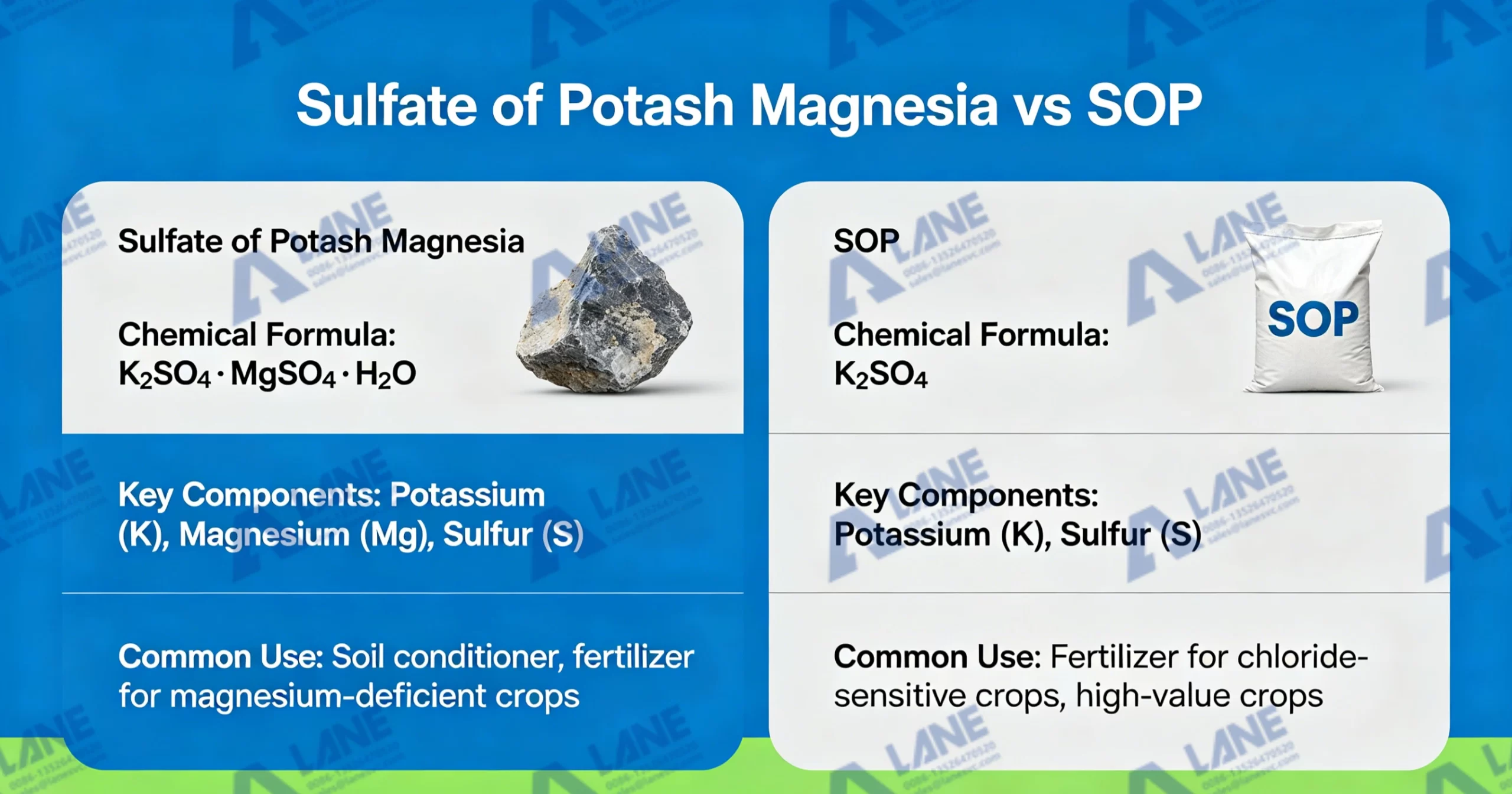
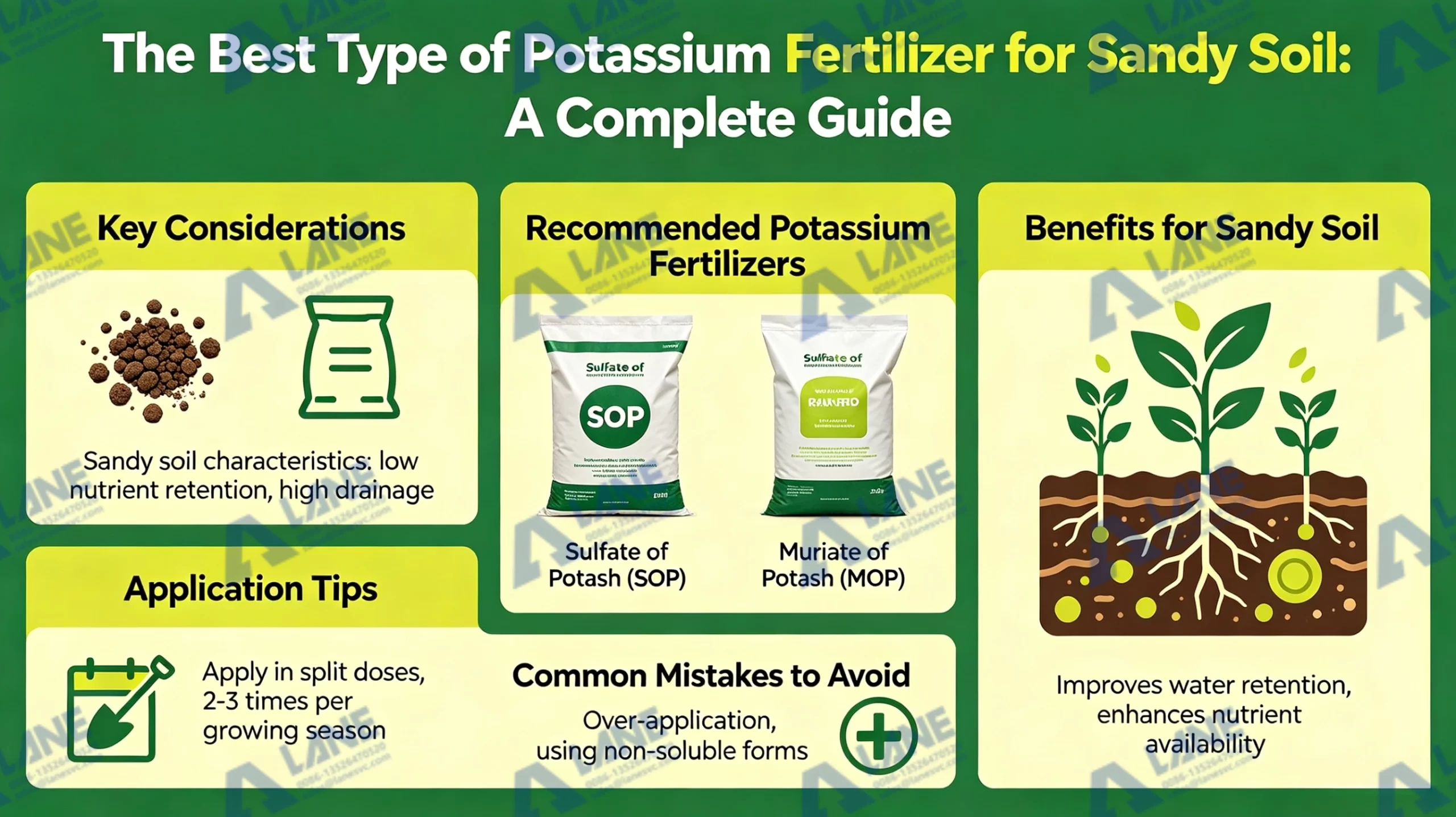
MOP and SOP in compound fertilizer production differ sharply in chemical properties, nutrient composition, and application boundaries. MOP, chemically known as potassium chloride (KCl), is the most widely used potassium fertilizer globally. It delivers approximately 60–62% K₂O and is cost-effective per unit of potassium. MOP is water-soluble and suitable for a broad range of chloride-tolerant crops, including rice, wheat, maize, and oil palm.
SOP, or sulfate of potash (K₂SO₄), contains approximately 50% K₂O and 17–18% sulfur in plant-available sulfate form. SOP is chloride-free, has a lower salt index, and is neutral to slightly acidic in soil effect. It protects root systems and soil microecology, which makes it ideal for high-value cash crops, fruits, vegetables, and saline soil cultivation. In the context of MOP and SOP in compound fertilizer production, SOP represents a higher-value, niche-oriented raw material that commands premium pricing but delivers distinct agronomic advantages.
The salt index of SOP is significantly lower than that of MOP. This means minimum risk of soil salinity accumulation, which is a critical consideration in arid regions. This is a key factor when evaluating MOP and SOP in compound fertilizer production for markets with challenging soil conditions.
The Agronomic Imperative: Chloride Sensitivity and Crop Quality
The selection between MOP and SOP in compound fertilizer production is determined by crop physiology and market demands. Chloride is an essential micronutrient in trace amounts, but can also be toxic to certain crops when accumulated beyond certain threshold levels. Chloride-sensitive crops include grapes, citrus, potatoes, tobacco, tea, strawberries, watermelons, bananas, and many vegetables. When they are exposed to excessive chloride, they exhibit reduced sugar content, impaired starch formation, leaf burn, and diminished storability and processing quality.
For instance, in citrus production, research comparing MOP and SOP in compound fertilizer production has demonstrated that SOP treatment results in higher sugar content, better fruit color, and improved yield compared to MOP-based formulations. Similarly, potato growers using SOP instead of MOP report fewer internal quality defects and better processing outcomes. In tobacco cultivation, chloride can severely impair leaf burn characteristics, making SOP the essential potassium source for fertilizer blends destined for tobacco farmers.
The following table summarizes crop chloride sensitivity and the corresponding potassium source recommendations:
| Crop Category | Chloride Sensitivity | Recommended Potassium Source |
| Tobacco, grapes, citrus, potatoes, strawberries, tea | Highly sensitive | SOP only |
| Tomatoes, peppers, cucumbers, soybeans, peanuts | Moderately sensitive | SOP preferred; limited MOP possible |
| Rice, wheat, maize, cotton, oil palm | Tolerant | MOP acceptable |
Compound fertilizer producers who know the distinctions and incorporate them into their compound fertilizer production strategies can develop product lines that command higher margins and build stronger farmer loyalty.
Compound Fertilizer Production: How LANE Heavy Industry’s Machinery Integrates MOP and SOP
The practical implementation of MOP and SOP in compound fertilizer production depends on the right equipment. LANE Heavy Industry Machinery Technology Co., Ltd., a leader in the fertilizer machinery manufacturing sector, offers equipment for compound fertilizer production lines which are designed for handling the raw material characteristics for both SOP and MOP fertilizer.
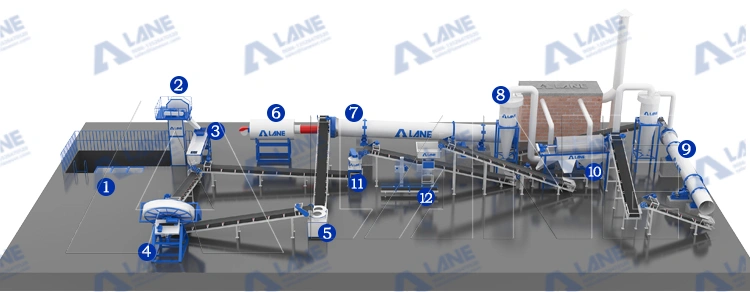
LANE Heavy Industry’s compound fertilizer production lines are fully automated and modular systems. Our production line integrates mixing, granulation, drying, cooling, screening, and packaging into a single cohesive operation. The core granulation equipment for industrial scale production is the Rotary Drum Granulator, which uses the wet granulation method, wherein steam or water is introduced to create the liquid phase necessary for particle agglomeration.
A typical 20 T/H NPK Production Plant configured by LANE Heavy Industry for MOP and SOP in compound fertilizer production includes the following key sections:
- Raw Material Storage and Handling: Silos for urea, phosphate sources, either MOP or SOP, and other micronutrients. LANE uses belt conveyors and bucket elevators for efficient material transfer.
- Batching and Mixing: Automatic dynamic batching systems ensure precise ratios of N, P, and K, with twin-shaft mixers producing a uniform blend.
- Granulation: LANE’s Rotary Drum granulator converts the mixed materials into uniform, high-strength granules with stable size and excellent appearance.
- Drying and Cooling: Rotary drum dryers reduce moisture to 2–3%, followed by coolers that prevent clumping and improve storage stability.
- Screening and Coating: Vibrating screens separate oversized and undersized granules for recycling, while coating drums apply coating for controlled release of fertilizer.
- Packaging: Automatic packaging machines weigh and pack fertilizers in 5–100 kg bags with consistency and efficiency.
One of the advantages of LANE Heavy Industry’s approach to MOP and SOP in compound fertilizer production is the customization which allows producers to switch between potassium sources.
Technical Considerations for MOP and SOP in Granulation
The physical and chemical properties of MOP and SOP influence the granulation behavior in compound fertilizer production lines. MOP has a higher solubility and can contribute to increased liquid phase formation during steam granulation. This can achieve strong agglomeration but may require careful moisture control to prevent over-granulation. SOP has a lower solubility and different crystallization characteristics. Producers will require adjustments to binder addition rates and steam parameters.
LANE Heavy Industry’s compound fertilizer production lines are engineered to accommodate these nuanced differences. Our experience in installing fertilizer production lines in over 60 countries has given us expertise in optimizing granulation parameters for both MOP and SOP in compound fertilizer production. Our machines can be fine-tuned for variables such as drum rotational speed, inclination angle, steam pressure (typically 0.3–0.5 MPa), and liquid binder spray rate to achieve optimal granulation results regardless of potassium source selection.
LANE Heavy Industry provides granulation experiment services, which allows clients to test specific raw material combinations including custom ratios of MOP and SOP in compound fertilizer production. This service is valuable for producers entering new markets or developing specialized fertilizer grades.
Economic and Market Dynamics: Balancing Cost and Value
The selection of MOP and SOP in compound fertilizer production is also dependent on economic realities. MOP is more affordable than SOP. Internationally, in some places, SOP can be priced nearly double that of MOP.
However, the higher cost of SOP is justified by the premium pricing of SOP-based compound fertilizers. Farmers growing chloride-sensitive, high-value crops are generally willing to pay more for SOP-containing NPK formulations. For compound fertilizer producers, the ability to offer both MOP-based and SOP-based product lines enabled by versatile production equipment from LANE Heavy Industry allows strategic market segmentation and improved overall profitability.
Sustainability and Soil Health Considerations
MOP’s chloride content is manageable for tolerant crops and well-drained soils, but it also contributes to gradual soil salinization in areas with limited rainfall or poor drainage. SOP contains less than 1.5% chloride and has a lower salt index, which makes it a more soil-friendly option in arid and semi-arid regions where salinity management is a pressing concern.
SOP provides sulfur, which is an essential secondary micronutrient that supports protein synthesis, enzyme function, and overall plant vigor. The dual-nutrient nature of SOP means that the compound fertilizer formulated with SOP eliminates the need for separate sulfur applications. This simplifies the farmers’ operations.
FAQ
Q1: What is the primary difference between MOP and SOP in compound fertilizer production?
MOP (Muriate of Potash) is potassium chloride (KCl) containing approximately 60–62% K₂O and 47% chloride. SOP (Sulfate of Potash) is potassium sulfate (K₂SO₄) containing approximately 50% K₂O, 17–18% sulfur, and zero chloride. The presence or absence of chloride is the defining distinction that determines crop suitability.
Q2: Which crops require SOP instead of MOP?
Chloride-sensitive crops that benefit most from SOP include tobacco, grapes, citrus fruits, potatoes, strawberries, watermelons, bananas, tea, apples, peaches, sugarcane, and various vegetables (peppers, tomatoes). These crops may suffer from reduced yield, impaired quality, and lower market value when exposed to the chloride in MOP.
Q3: Can I use both MOP and SOP in the same compound fertilizer production line?
Yes. LANE Heavy Industry‘s compound fertilizer production lines are designed to accommodate both potassium sources with minimal adjustments. The modular design and flexible granulation parameters allow producers to switch between MOP-based and SOP-based formulations to meet diverse market demands
Q6: Does LANE Heavy Industry provide installation and after-sales support?
Yes. LANE Heavy Industry offers comprehensive overseas installation services, a professional international after-sales team, and a five-year warranty on equipment. The company has successfully delivered projects in over 120 countries and provides free granulation experiment services to optimize formulations before production begins
Of course, we also offer other types of products for your different needs, you can click to view.
For more information, please contact us by sending an inquiry today! We can help you!



Write a Reply or Comment